
Quick answer
Void-free plywood is sold as having continuous inner veneers without the large open core gaps that can appear at a cut edge, in a dado or beneath a fastener. The phrase is useful, but it should be tied to the exact panel specification—not assumed from “cabinet grade,” a high ply count or a birch face.
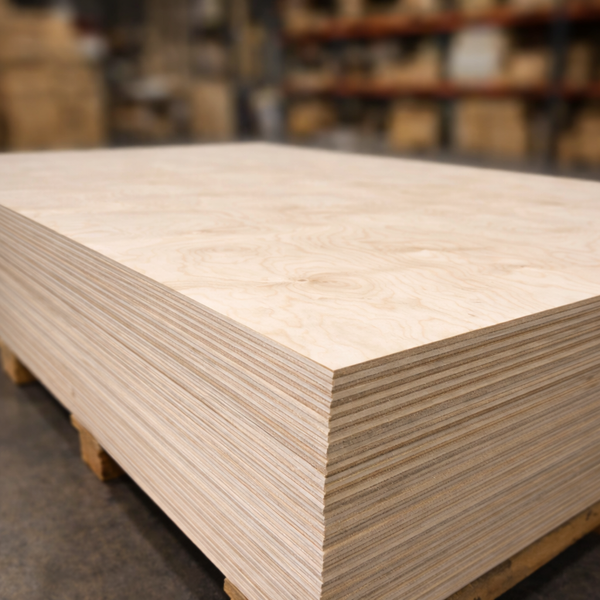
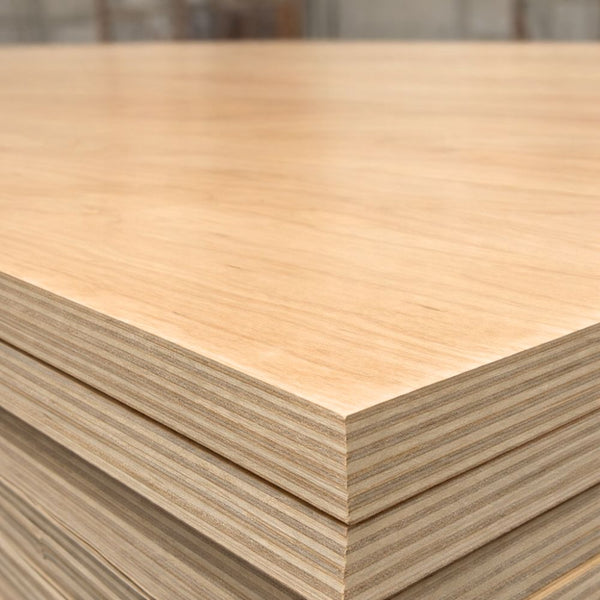
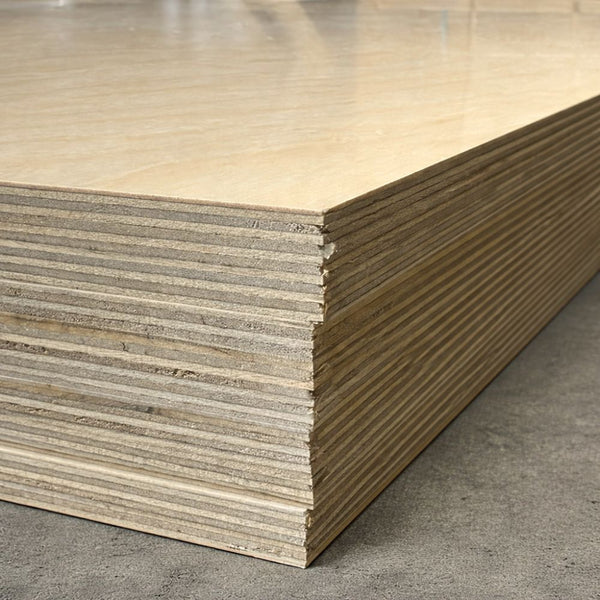
Berta’s current BB/BB Baltic Birch product page describes a solid birch, void-free core. That statement applies to that product as listed; it should not be transferred to every plywood sheet on the market. For CNC parts, exposed edges or small components, inspect a representative cut and order a sample when possible.
What counts as a plywood core void?
A core void is an open area inside the panel where an inner veneer does not fully meet the next piece or where a knot or defect leaves a gap. It may be invisible on the full sheet and appear only after cutting, routing or boring.
The USDA Forest Products Laboratory notes that when internal knotholes and voids are a problem—especially in small parts—plywood can be ordered with a solid core and face veneers. That is the practical reason cabinet shops care: a continuous core gives a more predictable edge and reduces the chance that a fastener or machined feature lands over an empty pocket.
Four plywood descriptions that answer different questions
| Description | What it tells you | What it does not prove | Best verification |
|---|---|---|---|
| Void-free core | The panel is represented as having continuous inner layers without large open gaps. | Face grade, exterior suitability, finish or exact thickness. | Exact product specification plus a sample or representative cut edge. |
| BB/BB grade | Both birch faces meet the stated BB appearance grade and may include sound repairs. | Ply count or a gap-free core unless separately stated. | Grade statement and inspection of both faces. |
| 13-ply | The panel has 13 wood veneer layers. | Void-free construction, face grade or bond classification. | Product data and a clean edge count. |
| WBP adhesive | The product lists a water-resistant weather-and-boil-proof bond description. | That an unfinished cabinet panel is automatically rated for permanent exterior exposure. | Manufacturer documentation and the project’s exposure requirement. |
| Cabinet grade | The seller considers the panel suitable for cabinet work under its stated specification. | A single universal construction shared by all suppliers. | Face, core, thickness, flatness, finish and application details. |
Where an open gap causes real shop problems
- Exposed edges: a void interrupts the striped edge and may require filling before a clear finish.
- CNC pockets and dados: machining can reveal a gap inside a feature that was supposed to have continuous glue area.
- Small parts: a gap occupies a larger share of a narrow rail, cleat or drawer component.
- Fasteners near edges: a screw that meets an open pocket has less wood surrounding the thread. Edge distance and pilot-hole practice still matter even in a solid core.
- Edge profiles: chamfers, roundovers and finger pulls expose more of the inner layup, making defects more visible.
- Repeat production: predictable edges reduce patching and rework when many matching cabinet parts are machined.
A solid core does not eliminate the need for proper joint design. Pilot holes, screw size, edge distance, grain direction and load remain part of the connection. Berta’s plywood screw-size chart covers that separate decision.
How to check core quality without ruining a full sheet
Read the exact listing
Look for an explicit core statement. Do not infer it from a photo or broad category name.
Order a sample
Compare face grade, edge appearance, thickness and finish before a large order.
Make a clean cut
Use a sharp blade and adequate support; tearout can look like a core defect.
Inspect the operation
Check a representative dado, bore or profile—not only the factory edge.
Keep one approved sample or offcut with the job record. If the project has a critical exposed edge or tightly nested small parts, define what is acceptable before production. “No visible large gaps on representative cut edges” is more actionable in a shop than an undefined quality adjective.
What is actually stated for BB/BB Baltic Birch
As checked on October 21, 2026, Berta’s BB/BB Baltic Birch page lists a 4 × 8 sheet, unfinished birch faces on both sides, a solid birch void-free core, WBP adhesive and long grain along the 8-foot direction. It offers 5 mm, 12 mm, 18 mm and 21 mm listed thicknesses. The 18 mm option is listed as 13-ply and the 21 mm option as 15-ply.
Those are product-specific statements. They do not establish a universal definition for all Baltic Birch, all BB/BB plywood or all 13-ply panels. The safest specification names the supplier, product, grade, thickness, finish and core claim together.
Verify the panel before a production order

BB/BB Baltic Birch 4 × 8
The current Berta panel that explicitly lists a solid birch, void-free core. Select the needed thickness, then measure and test the delivered material for the job.
Review current BB/BB specifications
Baltic Birch panel samples
Use samples to compare BB/BB, B/BB, clear prefinished and white melamine Baltic Birch before ordering full sheets. Check the exact selected sample and its edge.
Review Baltic Birch samplesCompare core, grade and thickness separately
- Baltic Birch grades, strength and cabinet uses
- what cabinet-grade plywood should mean in practice
- plywood core and thickness choices for shelves
- current Baltic Birch plywood collection
- cabinet-grade plywood categories
- BB/BB versus B/BB Baltic Birch comparison
- Baltic Birch panel-type selection page
- plywood cut-list and waste calculator
- plywood grade, thickness and delivery FAQ
Void-free plywood questions
Is all Baltic Birch plywood void-free?
Do not assume so from the species name. Verify the exact product. Berta currently describes its BB/BB panel as having a solid birch, void-free core; another panel may use different construction or quality language.
Does a high ply count mean there are no voids?
No. Ply count tells you how many wood layers form the panel. Core gaps are a separate quality issue. A 13-ply panel should still have an explicit core specification.
Can I see voids before buying a full sheet?
Sometimes they are visible at a factory edge, but a small sample or fresh offcut is more useful. Inspect the same kind of cut, dado or bore the project will use.
Does void-free plywood hold screws better?
A continuous core gives the screw a better chance of engaging wood rather than an open pocket, but holding also depends on veneer quality, pilot hole, screw geometry, edge distance, insertion direction and load.
Is void-free plywood waterproof?
No. Core continuity and moisture performance are different properties. Check adhesive and exposure documentation, protect cut edges as the application requires and do not infer exterior suitability from “void-free.”
Specify the exact panel, then inspect the cut
Void-free plywood is valuable where machining exposes the core or a gap could weaken a small part. The reliable buying sequence is simple: exact product claim, suitable grade and thickness, representative sample, clean test cut and approval before production. That process turns a vague quality phrase into a shop-ready material decision.
Berta product statements were checked on October 21, 2026. General plywood construction follows APA’s plywood overview. The practical impact of inner knotholes and voids is supported by the USDA Forest Products Laboratory’s Wood-Based Composite Materials chapter. Hardwood plywood terminology is also informed by ANSI/HPVA HP-1. These references do not certify a Berta product; Berta-specific claims come only from Berta’s current listing.