
Quick answer
“13-ply Baltic Birch” describes the number of veneer layers in a particular panel—not a universal grade and not a guarantee that every sheet sold as 3/4 inch has the same construction. Berta’s current BB/BB panel lists its nominal 3/4-inch option as 18 mm and 13-ply. The same product lists its 21 mm option as 15-ply; the product page does not state a ply count for the 12 mm or 5 mm options.
Ply count matters because many relatively thin cross-laminated veneers can create a stiff, stable panel with a clean-looking edge. It does not replace the other buying checks: actual thickness, face grade, core quality, bond type, flatness, finish and the specific job the panel must do.
Count the layers, not the dark glue lines
Plywood is built from veneers laid with alternating grain directions. APA describes this cross-laminated construction as a way to distribute strength and stiffness in both panel directions and improve dimensional stability. A ply is a wood veneer layer; the visible dark line between veneers is adhesive, not an extra ply.
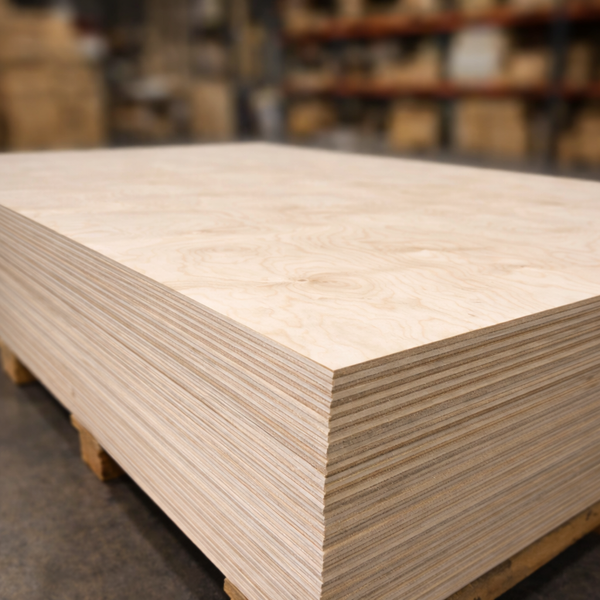
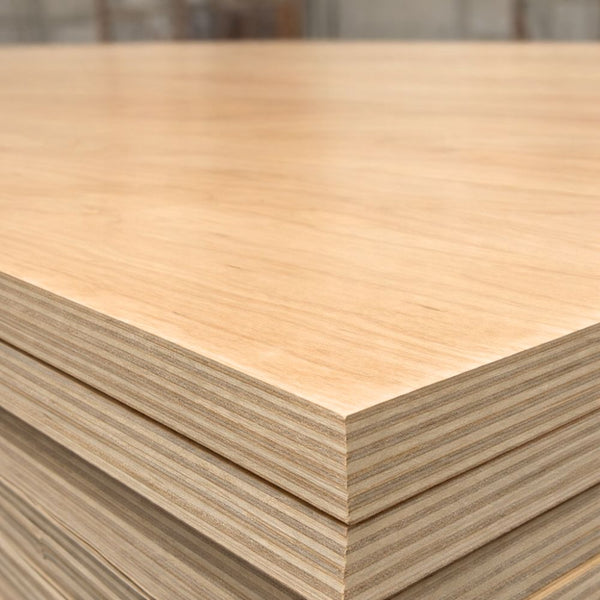
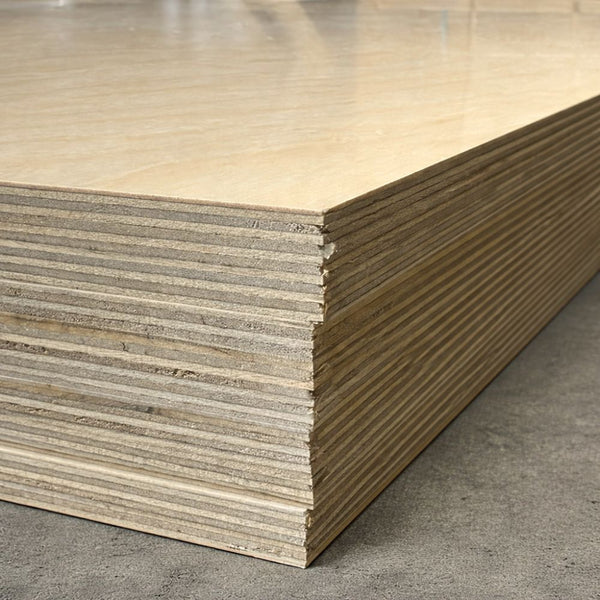
On a clean square cut, a 13-ply panel should show 13 wood layers from face to back. Because adjacent veneers alternate grain direction, end-grain and long-grain layers can reflect light differently. A rough saw cut, compressed edge or heavy finish can make the count harder to read.
Do not extrapolate one thickness to the whole product family
| Current BB/BB option | Listed metric thickness | Listed ply count | Planning note |
|---|---|---|---|
| Nominal 7/8 inch | 21 mm | 15-ply | Extra-thick work; 21 mm is about 0.827 inch, not exactly 0.875. |
| Nominal 3/4 inch | 18 mm | 13-ply | Cabinet boxes, furniture, shelving, built-ins and CNC work. |
| Nominal 1/2 inch | 12 mm | Not stated on the current product page | Choose by actual thickness and application; do not assume a count. |
| Nominal 3/16 inch | 5 mm | Not stated on the current product page | Thin parts such as backs, bottoms, templates and lightweight components. |
The current Berta page also describes the panels as 4 × 8 feet, BB/BB, unfinished and sanded on both sides, with a solid birch core and long grain running along the 8-foot direction. Specifications can change; confirm the product page and measure the delivered sheet before cutting dados, rabbets or CNC pockets.
What 13 plies can tell you—and what they cannot
Useful signal: layup density
For panels of similar thickness, more, thinner veneers can produce a refined edge and distribute wood defects across more layers. That can help with visible edges and detailed machining.
Separate check: core gaps
Ply count does not automatically prove a gap-free core. “Void-free” is a separate supplier or manufacturer claim that should be checked against the exact panel.
Separate check: face grade
BB/BB describes the two faces and permitted repairs. It does not mean “13-ply,” and another 13-ply panel may use a different face grade.
Separate check: bond and exposure
Adhesive specification affects moisture resistance. It does not make an unfinished cabinet panel automatically suitable for permanent exterior exposure.
Separate check: actual thickness
Hardware clearances and CNC joinery depend on the measured sheet, not the nominal inch label. Test a sample before batching parts.
Separate check: flatness
Even a dense layup should be stored and supported correctly. Inspect full sheets for bow, twist and handling damage before machining.
A five-minute receiving inspection
- Match the label to the order. Confirm the product, grade and thickness option before unwrapping a full stack.
- Measure the sheet. Check thickness in several places with calipers; use the measured value for joinery and hardware.
- Inspect both faces. BB/BB allows sound repairs, so plan visible parts around the actual face.
- Check a representative edge. Look for veneer continuity, gaps and crushed layers. A sample or offcut is safer than cutting a production panel first.
- Test the operation. Run one dado, screw, edge profile or finishing sample before releasing the full cut list.
For the broader terminology, see Berta’s explanation of plywood ply count. For sizing, compare the Baltic Birch thickness chart and the actual-versus-nominal plywood chart.
Check the exact panel before buying

Baltic Birch panel samples
Compare BB/BB, B/BB, clear prefinished and white melamine Baltic Birch before a full-sheet order. Use the selected sample to inspect surface, edge and actual thickness.
Review Baltic Birch samples
18 mm BB/BB Baltic Birch
This is the current Berta panel specifically listed as 13-ply. Check the BB/BB faces, unfinished surface, solid birch core and project-specific thickness before ordering.
Review the 13-ply panelContinue the material check
13-ply Baltic Birch questions
Is 13-ply Baltic Birch exactly 3/4 inch thick?
Not necessarily. Berta labels the option nominal 3/4 inch and lists it as 18 mm, which converts to about 0.709 inch. Measure the actual sheet for tight joinery and hardware fit.
Does 13-ply automatically mean void-free?
No. Ply count describes the number of wood layers. Core-gap quality is a separate specification. Berta currently describes its BB/BB product as having a solid birch, void-free core, but buyers should verify the exact product and inspect a representative edge.
Is 15-ply always better than 13-ply?
No. In Berta’s current BB/BB range, 15-ply corresponds to the thicker 21 mm panel and 13-ply to the 18 mm panel. Select thickness for the load, span, joint and hardware; do not choose by ply count alone.
Does BB/BB mean both faces are flawless?
No. BB/BB allows small, sound face repairs under the grade. Inspect both faces and orient visible parts based on the actual sheet.
Can a 13-ply edge be left exposed?
Yes, if the design accepts the striped edge and the machining is clean. Sand carefully, ease sharp corners and test the chosen finish on an offcut. Edge appearance is not a substitute for structural or moisture checks.
Use ply count as one verified specification
A 13-ply layup is meaningful when it is tied to a specific panel. For Berta’s current BB/BB range, that means the 18 mm option. Pair that fact with actual thickness, face grade, core claim, bond, flatness and a sample cut. That is a much safer buying method than assuming every “3/4-inch Baltic Birch” sheet is built the same way.
Product-specific statements were checked against the Berta Store BB/BB product page on October 21, 2026. General plywood construction follows APA’s plywood construction overview and the ANSI/HPVA HP-1 hardwood plywood standard. Always use the current product page, label, sample and delivered-sheet measurements for fabrication.