
Quick answer
Use 3/4-inch prefinished plywood for most cabinet boxes, end panels, substantial shelves and built-ins; 1/2 inch for lighter backs, drawer components and interior parts designed around that thickness; and 1/4 inch for captured backs, drawer bottoms and skins—not unsupported structural parts.
That is a starting point, not a universal cabinet rule. Span, loading, support, joinery, hardware clearance and the panel’s actual measured thickness control the final choice. Berta’s current prefinished range lists 3/4 inch as 18 mm, 1/2 inch as 12 mm and 1/4 inch as 6 mm.
Match thickness to the job the part must do
| Cabinet part | Common starting thickness | Why it works | What can change the choice |
|---|---|---|---|
| Base or wall cabinet sides | 3/4 inch / 18 mm | Provides material for dados, screws, confirmats and edge fastening. | Engineering, frameless system details, applied ends and hardware. |
| Fixed cabinet shelves | 3/4 inch / 18 mm | Useful balance of stiffness and edge thickness for typical cabinet work. | Clear span, load, edge reinforcement and number of supports. |
| Adjustable shelves | 3/4 inch / 18 mm | Fits common shelf-pin systems and resists sag better than thinner panels of the same construction. | Long spans or heavy loads may need a thicker panel, solid edge or center support. |
| Full cabinet back | 1/2 or 3/4 inch | A substantial back can square the cabinet and support mounting strategy. | Whether the back is load-bearing, planted on, rabbeted, or supplemented by rails. |
| Captured cabinet back | 1/4 inch / 6 mm | Efficient where the panel sits in a groove and is supported around the perimeter. | Wall fastening method, cabinet width and whether the back must carry load. |
| Drawer sides | 1/2 inch / 12 mm | Reduces weight while leaving useful material for joinery. | Drawer size, joint, slide system and the manufacturer’s drawer specifications. |
| Drawer bottom | 1/4 or 1/2 inch | 1/4 inch suits smaller captured bottoms; 1/2 inch adds stiffness for wider or heavier drawers. | Groove depth, bottom support, drawer width and expected load. |
| Decorative skin or applied panel | 1/4 inch / 6 mm | Adds a finished face without the mass of a structural panel. | Edge exposure, substrate flatness, adhesive and moisture conditions. |
The finished-side count changes with thickness
Berta’s current 4 × 8 prefinished cabinet-grade plywood is offered in natural birch with a UV-cured clear finish or white melamine, over a multi-ply poplar plywood core. The 3/4-inch and 1/2-inch panels are listed as finished on both sides. The 1/4-inch panel is listed as finished on one side.
Two finished sides
Useful for cabinet interiors, open shelving, partitions and components where both faces can remain visible. It also avoids planning a hidden unfinished face.
One finished side
Appropriate for a skin, captured back or drawer bottom when only the exposed face needs the factory surface. Mark the finished face before cutting.
Do not infer a finish configuration from thickness alone across other brands or product families. Confirm the exact variant. Berta’s prefinished maple product, for example, is a separate panel family with its own face, core and ply-count specifications.
Nominal labels do not size a dado
Nominal inch labels are convenient for ordering, but cabinet joinery must fit the actual sheet. Measure several locations with calipers after the material has reached the shop. Then cut one test dado or rabbet from an offcut before machining production parts.
toolpath width = measured panel thickness + only the clearance your assembly method requires.
A “1/2-inch” part listed as 12 mm is about 0.472 inch, while an 18 mm part is about 0.709 inch. Those differences matter for dado width, back-set calculations, drawer openings, hinge plates and slide clearances. Do not substitute decimal conversions for a real measurement when the fit is critical.
Plan the panel before the cut list
- List cabinet parts by function. Separate structural sides and shelves from backs, bottoms and skins.
- Mark visible faces. Record whether each part needs one or two finished faces and which direction the birch grain should run.
- Set the hardware system. Drawer slides, hinges and connectors can lock in part thicknesses or clearances.
- Choose the panel family. Natural birch UV and white melamine solve different visual and edge-matching problems even when thickness is the same.
- Measure and test. Verify actual thickness and run one representative joint before nesting the full sheet.
- Optimize the yield. Use a cut-list tool only after grain direction and finished-face orientation are fixed.
Berta’s UV-finished plywood explanation covers what the factory coating changes. Compare that with the prefinished-versus-unfinished decision guide and the 1/2-inch plywood guide.
Exact current thickness images

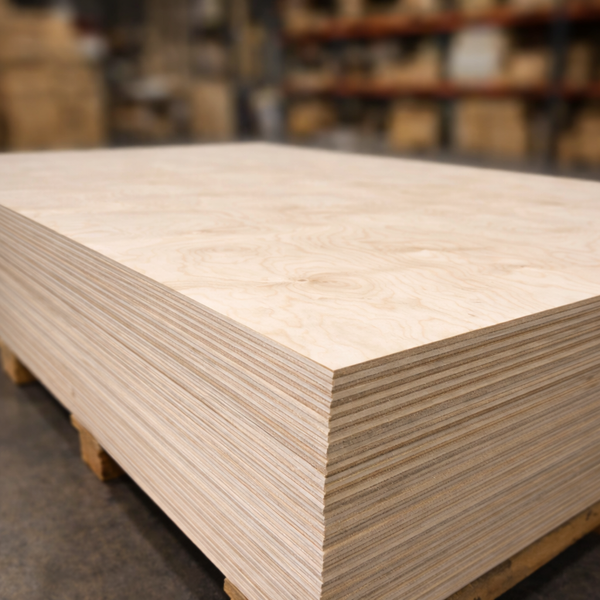
Birch / 3/4 inch (18 mm)
Two finished sides; the starting point for cabinet boxes, end panels, shelving and built-ins. Confirm span, load and actual thickness.
Review the 18 mm birch panel
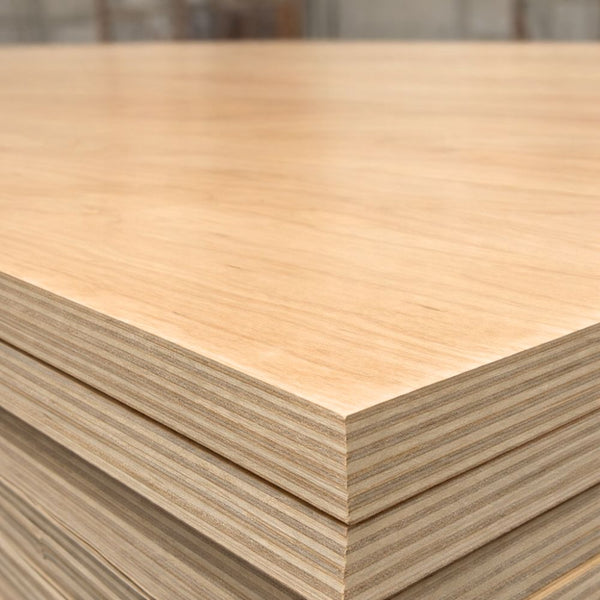
Birch / 1/2 inch (12 mm)
Two finished sides for lighter cabinet components, backs and drawer parts designed for the thinner panel.
Review the 12 mm birch panel
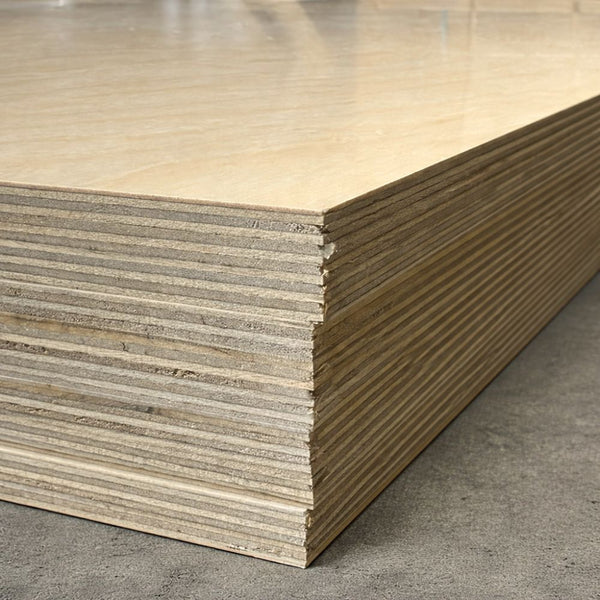
Birch / 1/4 inch (6 mm)
One finished side for captured backs, drawer bottoms, skins and other supported thin-panel work.
Review the 6 mm birch panelBuild the cut plan around the material
Prefinished plywood thickness questions
Is 1/2-inch prefinished plywood strong enough for cabinet sides?
It can be used in systems engineered around thinner sides, but 3/4 inch is the more common starting point for conventional cabinet boxes because it offers more material for joinery and fasteners. Treat construction method, load and hardware as a system.
Can 1/4-inch plywood be used for a cabinet back?
Yes, when it is captured in a groove or otherwise supported and the cabinet’s wall-mounting method does not depend on that thin panel alone. Use rails or a thicker back where the back carries installation loads.
Should drawer bottoms be 1/4 or 1/2 inch?
Use 1/4 inch for smaller, captured bottoms with modest loads. Move to 1/2 inch or add support for wider or heavily loaded drawers. Groove depth and slide clearance must be planned with the chosen thickness.
Are the Berta 1/4-inch panels finished on both sides?
No. The current prefinished plywood page lists the 1/4-inch panel as finished on one side. It lists the 1/2-inch and 3/4-inch panels as finished on both sides.
Can I use the nominal thickness for CNC dados?
No. Measure the sheet and cut a test joint. The product’s metric listing is more informative than the nominal inch name, but the actual delivered panel is the correct reference for a close fit.
Use the thickest panel only where the part earns it
Most cabinet projects become clearer once parts are separated into structural panels, supported thin panels and decorative skins. Use 18 mm where stiffness, joinery and edge thickness matter; 12 mm where a lighter part is intentionally designed around it; and 6 mm where a captured or applied panel only needs one finished face. Then measure, prototype and optimize the cut list.
Berta product dimensions, core, surface and finished-side statements were checked on October 21, 2026 against the current prefinished plywood and sample pages. General plywood construction follows APA’s plywood overview. Panel application recommendations are practical cabinet-planning guidance; final spans, loads, joinery and hardware must be verified for the actual project.