
Thin-panel selection
Quick answer
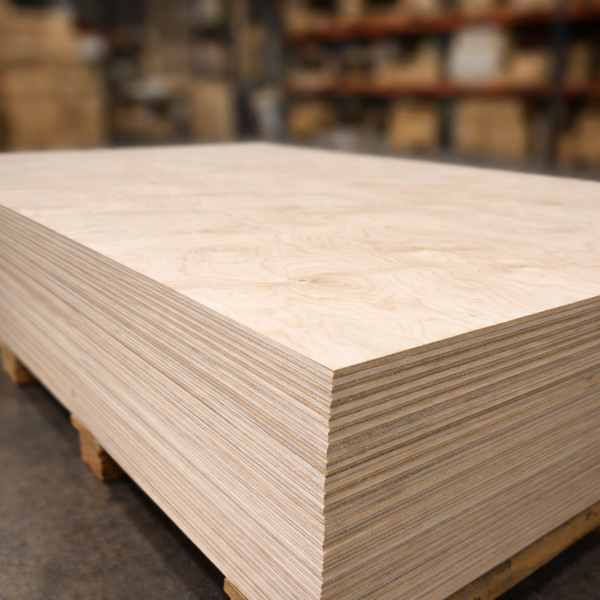
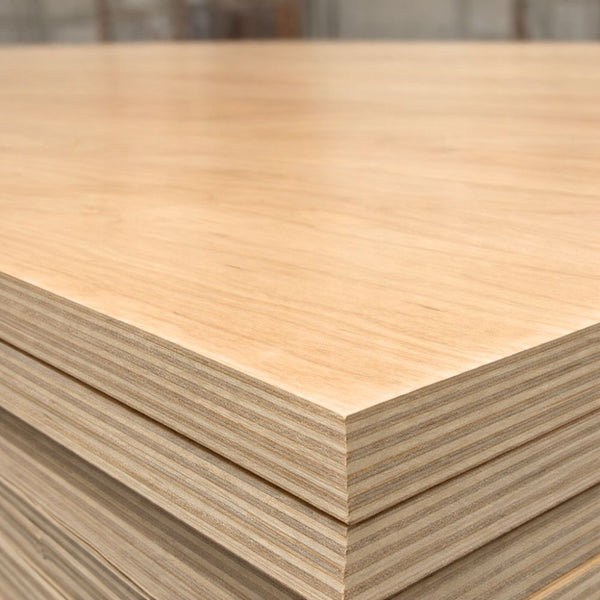
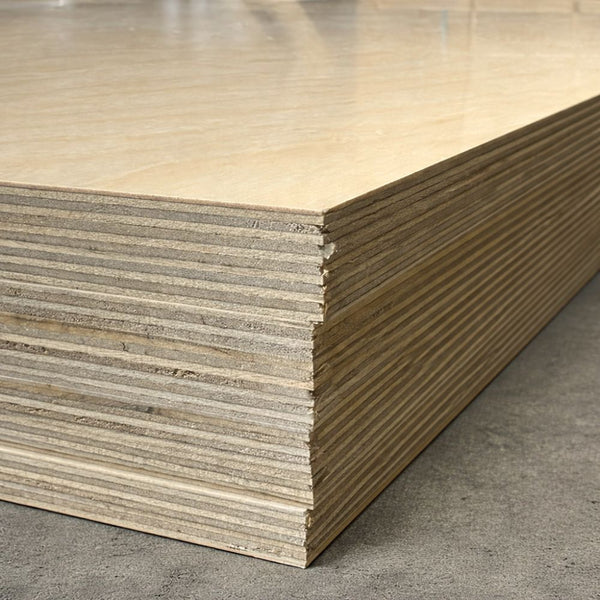
For thin plywood sheets in a 4×8 format, 3/16 inch and 1/4 inch are close in name but not interchangeable. Berta Store’s current 3/16-inch Baltic Birch is listed at 5 mm, unfinished on both sides, with a solid birch core. The current 1/4-inch prefinished panel is listed at 6 mm, with a multi-ply poplar core and a Birch UV or White Melamine face finished on one side.
Choose 3/16-inch Baltic Birch when an unfinished, all-birch thin panel suits the part. Choose 1/4-inch prefinished plywood when a ready-to-use interior face is more valuable than the 1 mm thickness difference. For drawer bottoms and backs captured in grooves, measure the actual sheet and cut the groove to the material.
Side-by-side
3/16-inch vs 1/4-inch plywood
| Decision point | 3/16 in. Baltic Birch | 1/4 in. prefinished plywood | Why it matters |
|---|---|---|---|
| Listed metric thickness | 5 mm | 6 mm | A fixed groove for one may not properly fit the other. |
| Current Berta core | Solid birch core | Multi-ply poplar core | Core species and construction affect edge appearance, weight and machining feel. |
| Current face condition | BB/BB, unfinished both sides | Birch UV or White Melamine; 1/4-inch listed as finished one side | One requires a shop-applied finish if protection or sheen is wanted; the other can provide a ready interior face. |
| Useful starting applications | Templates, jigs, unfinished cabinet backs, shop fixtures and thin components | Cabinet backs, light-duty drawer bottoms and interior panels where a finished face is useful | The face requirement can be more important than the nominal fraction. |
| Joinery check | Measure the actual sheet; test groove on an offcut | Measure the actual sheet; orient the finished face correctly | Nominal names do not replace a measured machining setup. |
| Design caution | Neither nominal thickness establishes a universal load rating or unsupported span. | Bottoms and backs need support appropriate to part size, load and construction. | |
Application map
Where each thin panel earns its place
Cabinet backs
A captured back can help keep a cabinet square, but its performance depends on groove depth, fasteners, cabinet size and installation. Use the finished face toward the cabinet interior when appearance and cleanability matter.
Drawer bottoms
A small, lightly loaded drawer and a wide file drawer do not ask the same thing of a bottom. Treat 3/16 or 1/4 inch as a material choice—not a blanket load rating—and add support when the geometry or load requires it.
Templates and jigs
Unfinished 3/16-inch Baltic Birch is a useful starting point when a thin, consistent template must be marked, drilled or modified. Seal it if the shop process needs a more durable surface.
For more context, use the 3/16-inch plywood material overview, the actual plywood thickness chart, and the drawer-box plywood thickness chart. Those references cover thickness families; this article focuses on the thin 4×8 selection decision.
Groove fit
Why one millimeter changes the machining setup
Five millimeters is approximately 0.197 inch. Six millimeters is approximately 0.236 inch. The difference is only about 0.039 inch, but that is large in a joinery fit. A groove tuned to a measured 5 mm panel may not accept a measured 6 mm sheet; a groove cut for the thicker material may leave the thinner panel loose.
measured panel thickness + desired fit allowance = test groove width
There is no universal allowance because the right fit depends on the joint, tooling, humidity, coating and assembly method. Measure several points on the sheet, cut a test groove in scrap from the same setup, and assemble a sample before cutting cabinet sides.
Current matching panels
Two distinct thin-sheet routes

3/16-inch (5 mm) Baltic Birch BB/BB
Choose this current 4×8 panel when an unfinished, solid-birch thin sheet fits the job. It is listed as unfinished on both sides. Check actual thickness, face appearance and finishing requirements before fabrication.
Check 3/16 Baltic Birch details
1/4-inch (6 mm) Birch prefinished plywood
Choose this current 4×8 panel when a Birch UV-finished face can reduce finishing work on a cabinet back or interior component. The 1/4-inch version is listed as finished on one side; orient that face deliberately.
Check 1/4 prefinished detailsAvoidable errors
Five mistakes to catch before cutting
Buying by fraction only
“3/16” and “1/4” do not tell you core species, face grade, finish or actual measured thickness.
Routing every groove first
One inaccurate setup multiplies across the job. Test the joint with the delivered material before production machining.
Assigning a universal capacity
Panel thickness alone does not establish drawer-bottom load capacity. Opening size, capture, support, load distribution and construction all matter.
Flipping a one-sided finish
Mark the finished side as parts leave the saw so the cabinet interior stays consistent.
Skipping cut width
Include saw-kerf loss when nesting parts. The plywood kerf allowance reference explains why nominal sheet area is not all usable part area.
Frequently asked questions
Thin plywood questions
Is 3/16-inch plywood the same as 1/4-inch plywood?
No. In the current Berta products compared here, 3/16 inch is listed at 5 mm and 1/4 inch at 6 mm. They also use different cores and face/finish systems.
Which is better for a cabinet back?
Use the part design to decide. The prefinished 1/4-inch panel provides a ready face for an interior. The unfinished 3/16-inch Baltic Birch may suit a thin back that will be finished separately. Groove capture, cabinet dimensions and installation method still need to be engineered for the cabinet.
Can 3/16-inch plywood be used for drawer bottoms?
It can be considered for appropriately sized, lightly loaded drawers with suitable capture and support, but the nominal thickness is not a load rating. Evaluate the drawer opening, expected load and construction.
Does 1/4-inch prefinished plywood have finish on both sides?
The current Berta product listing states that the 1/4-inch version is finished on one side. Confirm the selected variant and reverse-face appearance on the product page before ordering.
What cutter should be used for a 5 mm or 6 mm panel?
Use measured material and a test cut rather than assuming a nominal cutter will produce the desired fit. Cutter runout, coating and the joint’s fit allowance can all change the result.
Planning tools
Continue the material takeoff
- 3/16-inch Baltic Birch collection
- 1/4-inch 4×8 plywood collection
- full plywood collection
- plywood cut-list calculator
- cabinet and sheet-goods calculators
- plywood delivery calculator