
Shelves fail for predictable reasons. They sag, twist, chip at the edges, or pull fasteners loose—not because plywood is automatically weak, but because the wrong panel, thickness, or support layout was selected for the span and load.
Professionals selecting plywood for shelves focus on four factors: unsupported span, panel thickness, core construction, and surface durability. The right combination limits deflection and edge damage. The wrong combination can create avoidable installation problems and callbacks.
Plywood Options for Shelves and Cabinet Interiors
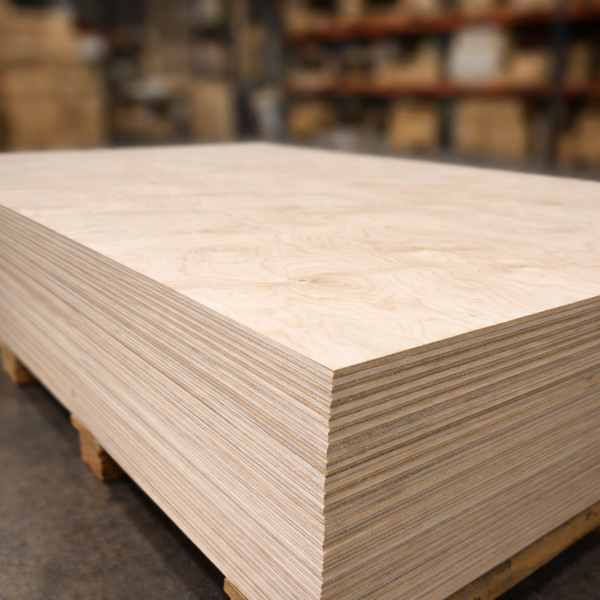
Choose unfinished Baltic Birch when core consistency, clean machining, and edge strength matter. Choose prefinished cabinet plywood when the shelf needs a ready-to-use interior surface with less finishing work.

Baltic Birch Plywood BB/BB
Multi-ply Baltic Birch for loaded shelves, bookcases, cabinets, furniture, jigs, and projects where clean edges matter.
View Baltic Birch
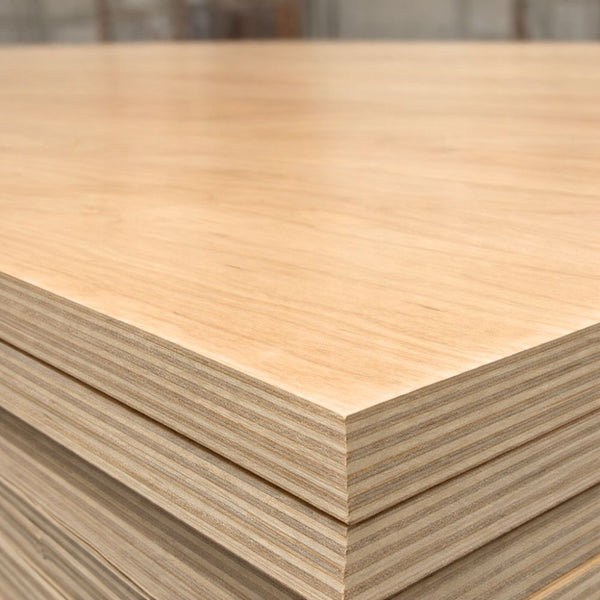
Prefinished Cabinet Plywood 4×8
Ready-to-use cabinet plywood for shelves, closets, pantry interiors, built-ins, kitchens, and commercial millwork.
View Prefinished PlywoodWhat Actually Causes Shelf Sagging
Shelf sag is controlled by more than plywood grade. The complete shelf assembly determines how the panel performs over time.
- Unsupported span: Longer shelves deflect more than shorter shelves made from the same panel.
- Panel thickness: A small increase in thickness produces a substantial increase in bending stiffness.
- Core construction: Multi-ply, consistent cores generally perform more predictably than panels containing large gaps or weak inner veneers.
- Shelf depth: Deeper shelves normally carry more material and can place more total load across the same span.
- Load weight and duration: Books, tools, dishes, and storage bins create more long-term stress than light decorative items.
- Front-edge reinforcement: A structural hardwood nosing or front rail can reduce deflection. Thin decorative edge banding does not provide the same result.
- Support layout: Side panels, shelf pins, rear cleats, brackets, and center dividers all affect the final unsupported distance.
Many shelf failures occur when 3/4-inch plywood is treated as a universal solution for every span. Even good plywood can gradually deflect when it carries a continuous heavy load without enough support.
Shelf Thickness and Support-Span Guide
The following ranges are practical starting points for interior plywood shelves approximately 10 to 12 inches deep with evenly distributed loads. Heavier loads, deeper shelves, weaker cores, or high-humidity environments may require shorter spans.
| Shelf construction | Practical clear span | Typical use | Support guidance |
|---|---|---|---|
| 1/2-inch cabinet plywood | About 18–24 inches | Small cabinet shelves, light displays, folded linens, and lightly loaded interior storage | Support on the sides and along the back when possible. Avoid long spans carrying books, tools, or heavy dishes. |
| 3/4-inch standard cabinet plywood | About 24–30 inches | Kitchen cabinets, pantry shelves, closets, built-ins, and general household storage | Add front reinforcement or a center support sooner when the shelf will carry dense or continuous loads. |
| 3/4-inch Baltic Birch | About 30–36 inches | Bookcases, shop storage, furniture, exposed-edge shelves, and more demanding cabinet installations | For books, tools, stoneware, or deep shelves, support closer to the lower end of the range. |
| 3/4-inch plywood with solid-wood front nosing | About 30–36 inches depending on the panel and nosing | Wider visible shelves where a finished hardwood front edge is appropriate | Use a continuous glue bond. Thin iron-on veneer or PVC edge banding should not be counted as structural reinforcement. |
| Any loaded shelf over 36 inches | Add support | Long closet shelves, wide bookcases, tool storage, and full-width cabinet runs | Use a vertical divider, center bracket, structural front rail, or another support method instead of relying on panel thickness alone. |
These ranges are planning guidelines, not structural load ratings. Actual deflection depends on the panel’s core and stiffness, shelf depth, load distribution, attachment method, humidity, and the length of time the load remains on the shelf.
1/2-Inch vs 3/4-Inch Plywood for Shelves
Use 1/2-Inch Plywood When
- The clear span is approximately 18–24 inches or less
- The shelf will carry light, evenly distributed items
- The back and side edges receive continuous support
- Reducing panel weight is important
- The shelf is part of a small cabinet or compartment
Use 3/4-Inch Plywood When
- The shelf will carry books, dishes, appliances, or storage bins
- The span is wider than approximately 24 inches
- The shelf is adjustable and supported mainly by shelf pins
- Better edge strength and fastener holding are needed
- The installation must resist visible long-term deflection
For most cabinet and built-in shelving, 3/4-inch plywood is the more forgiving choice. It provides more material around shelf-pin and fastener locations and is substantially stiffer than a comparable 1/2-inch panel.
Remember that nominal plywood may measure slightly thinner than its stated size. Review the actual plywood thickness chart before designing dados, shelf-pin layouts, or fixed openings. You can also read why nominal plywood thickness differs from actual thickness .
How Professionals Evaluate Plywood for Shelving
Core Construction Matters More Than Surface Appearance
A clean face veneer does not guarantee a stiff or durable shelf. Professionals examine the inner core, ply count, visible gaps, edge quality, and consistency from sheet to sheet.
A panel with a smooth face but an inconsistent core may machine poorly, split around fasteners, or deflect sooner than expected. Multi-ply cores usually produce cleaner edges and more predictable shelf performance.
Baltic Birch vs Standard Cabinet Plywood
| Feature | Baltic Birch plywood | Standard cabinet plywood |
|---|---|---|
| Core construction | Usually built with many thin birch plies and a visually consistent multi-ply edge | May use veneer, poplar, combination, or other cabinet-grade cores depending on the panel |
| Stiffness and consistency | Commonly selected where predictable machining and resistance to deflection are priorities | Can perform very well, but stiffness varies more by core type, ply count, and manufacturer |
| Exposed edges | Multi-ply edges can be sanded and clear-finished as part of the design | Edges are more commonly covered with veneer, PVC, ABS, or solid-wood banding |
| Machining and fasteners | Well suited to dadoes, rabbets, shelf pins, and precision joinery when machined correctly | Face fastener holding is generally good; edge performance depends heavily on the specific core |
| Finished surfaces | Available unfinished or with selected finished surfaces, including white melamine options | Commonly available with UV coating, melamine, maple, birch, or other ready-to-use cabinet surfaces |
| Best application | Loaded shelves, exposed-edge furniture, shop fixtures, jigs, bookcases, and precision work | Cabinet interiors, closets, pantry shelving, built-ins, and projects where finished surfaces and production efficiency matter |
“Standard cabinet plywood” is a broad category. Always compare the actual core, ply count, panel thickness, and surface specification rather than assuming every cabinet-grade sheet performs the same way. For a maple-faced option, review maple plywood thickness selection while keeping the shelf’s span and support requirements in view.
Multi-Ply Baltic Birch for Loaded or Exposed Shelves
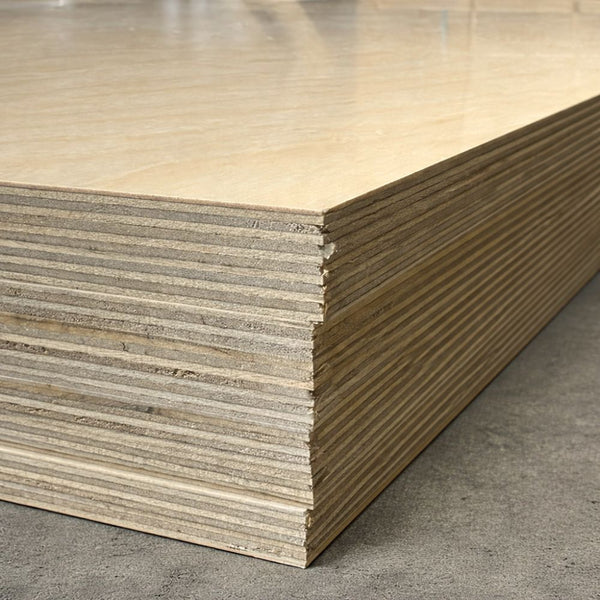
Baltic Birch is useful when shelves need a consistent core, clean routed edges, reliable machining, or an exposed multi-ply appearance. It is commonly selected for bookcases, furniture, shop fixtures, and cabinet shelves carrying moderate to heavy loads.
Review Baltic Birch plywood BB/BB when unfinished multi-ply construction and edge quality are the main priorities.
Prefinished Plywood for Finished Cabinet Interiors
A shelf does not always need an exposed wood face. For cabinet interiors, closets, pantry shelves, and commercial millwork, a ready-to-use finished surface can reduce sanding, coating, drying time, and cleanup.
Prefinished plywood 4×8 sheets are a practical alternative when the project needs a clean finished interior surface. Exposed shelf edges should still be covered with the appropriate edge banding or solid-wood nosing.
White Melamine Baltic Birch for Clean Interior Shelves
When a white finished surface and a multi-ply core are both important, 4×8 white melamine Baltic Birch plywood can be used for cabinet interiors, closets, shelving, retail fixtures, and modern built-ins.
Film-Faced Baltic Birch for Utility Shelves
In garages, workshops, and utility rooms, surface abrasion and occasional moisture exposure may matter more than natural wood appearance. Baltic Birch film-faced plywood provides a more durable surface than unfinished plywood, although cut edges, joints, and fastener penetrations still require appropriate protection.
How Edge Banding Affects Shelf Stiffness
Edge banding and edge reinforcement are not the same thing. Most thin edge banding improves appearance and protects the exposed plywood edge, but it should not be expected to prevent shelf sag.
| Edge treatment | Primary purpose | Effect on shelf stiffness |
|---|---|---|
| Thin veneer edge banding | Covers the plywood edge and creates a matching wood appearance | Minimal structural effect. Treat it as a finish, not reinforcement. |
| PVC or ABS edge banding | Improves edge appearance and impact resistance | Minimal effect on sag resistance, even when the banding is thicker than veneer. |
| Solid-wood front nosing | Protects the edge and creates a finished hardwood front | Can materially improve stiffness when the nosing is deep enough and continuously glued to the shelf. |
| Structural front rail or apron | Becomes part of the shelf or cabinet framework | Can provide substantial reinforcement when properly integrated with the shelf and cabinet sides. |
A decorative edge strip cannot correct an excessive unsupported span. When sag resistance is the goal, use solid-wood nosing, a structural front rail, or an additional support point.
For a detailed comparison of veneer, PVC, and other finishes, read the guide to choosing edge banding for plywood .
When a Center Support Is Required
A center support is usually more reliable than trying to solve every long-span problem with thicker plywood. It reduces one long unsupported shelf into two shorter, stiffer sections.
Plan for a center support when one or more of the following conditions apply:
- The clear shelf span exceeds approximately 36 inches
- 1/2-inch plywood must span more than approximately 24 inches
- The shelf will hold books, tools, stoneware, appliances, or bulk supplies
- The shelf is unusually deep or will be loaded from front to back
- The load will remain in place continuously for months or years
- The plywood has a lower-ply or inconsistent veneer core
- A solid-wood front nosing or structural rail cannot be used
- Visible long-term sag would affect doors, drawer clearances, or finished alignment
Where Standard Plywood Shelves Commonly Fail
- Wide closet shelves installed without a center divider or bracket
- Garage shelves loaded with tools, paint, or equipment
- Bookcases spanning more than 30–36 inches without reinforcement
- Deep pantry shelves carrying appliances, dishes, or bulk food
- 1/2-inch adjustable shelves used for medium or heavy storage
- Low-grade plywood containing large core gaps or inconsistent veneers
Construction-grade plywood may look acceptable when first installed, but its surface quality, core consistency, and edge machining can vary considerably. It is usually better suited to utility shelving than visible cabinet interiors or finished furniture.
Edge Quality and Fastener Holding
Shelves can also fail around their edges and support points. Poor or inconsistent core construction may lead to:
- Chipped or broken exposed edges
- Fastener blow-out near the panel edge
- Loose shelf pins or damaged pin holes
- Uneven edge-banding adhesion
- Voids exposed during routing or dado cutting
Multi-ply cores generally provide more consistent material around dados, rabbets, shelf pins, and brackets. Fasteners should still be correctly sized, positioned away from fragile edges, and predrilled when the application requires it.
Common Buyer Mistakes
- Choosing plywood by face appearance without checking the core
- Using 3/4-inch plywood as a universal solution for every span
- Ignoring the weight of books, tools, dishes, or storage bins
- Using 1/2-inch plywood for long adjustable shelves
- Treating thin veneer or PVC edge banding as structural reinforcement
- Ignoring the additional load created by deeper shelves
- Skipping center support on shelves wider than approximately 36 inches
- Designing dados and hardware around nominal rather than actual thickness
When Each Plywood Type Is the Right Choice
Use Standard Cabinet Plywood When
- Shelves are approximately 24–30 inches wide or less
- The load is light to moderate
- Exposed edges will be covered
- Weight and project cost matter
- The selected core has been checked for quality and consistency
Use Baltic Birch When
- Shelves need greater core consistency
- The span or load is more demanding
- Exposed multi-ply edges are part of the design
- Precision machining, dadoes, or routed edges are required
- Edge strength and repeatable shop results are priorities
Use Prefinished Cabinet Plywood When
- The shelf needs a ready-to-use interior surface
- The project includes closets, pantry interiors, or built-ins
- Reducing sanding and finishing labor is important
- Exposed edges will receive compatible edge banding or nosing
- A clean and repeatable production finish is required
Use Film-Faced Plywood When
- Shelves are used in workshops, garages, or utility spaces
- Surface abrasion is expected
- Occasional moisture exposure is possible
- Surface durability matters more than natural wood appearance
Additional cabinet-grade and multi-ply options can be reviewed in the complete plywood collection .
Frequently Asked Questions
Is 3/4-Inch Plywood Enough for Shelves?
Yes, 3/4-inch plywood is suitable for most cabinet and closet shelves with moderate loads and clear spans of approximately 24–30 inches. High-quality multi-ply panels may work across wider spans, but shelves approaching or exceeding 36 inches should normally receive reinforcement or center support.
Should I Use 1/2-Inch or 3/4-Inch Plywood for Shelves?
Use 1/2-inch plywood for short, lightly loaded shelves with good side and back support. Use 3/4-inch plywood for wider adjustable shelves, books, dishes, pantry storage, appliances, or other continuous loads.
How Far Can 3/4-Inch Plywood Span Without Sagging?
Standard 3/4-inch cabinet plywood is commonly used for spans around 24–30 inches. High-quality 3/4-inch Baltic Birch may be used around 30–36 inches under appropriate loads. The exact limit depends on shelf depth, load, core construction, support method, humidity, and acceptable deflection.
Does Edge Banding Prevent a Plywood Shelf From Sagging?
Thin veneer, PVC, melamine, or ABS edge banding does not provide meaningful structural reinforcement. A continuously glued solid-wood front nosing or structural front rail can improve shelf stiffness, but it does not replace center support on excessively long spans.
When Should I Add a Center Support?
Add center support when the shelf is wider than approximately 36 inches, carries dense or continuous loads, is unusually deep, uses 1/2-inch plywood across a long span, or cannot accept a structural front edge.
Is Baltic Birch Better Than Standard Cabinet Plywood for Shelves?
Baltic Birch is often better for loaded shelves, precision machining, and exposed multi-ply edges. Standard cabinet plywood may be the more efficient option for shorter spans, moderate loads, and finished cabinet interiors. The correct choice depends on the actual core and application.
Can Construction Plywood Be Used for Shelves?
Construction plywood can be used for basic utility shelving, especially when appearance is not important. It is less suitable for visible cabinets and furniture because the faces, edges, core consistency, and machining quality may vary.
Final Thoughts
The best plywood for shelves is determined by the complete shelf system: span, load, thickness, core construction, edge treatment, and support layout. No panel grade can compensate indefinitely for an excessive unsupported span.
Use 3/4-inch cabinet plywood as the general starting point, Baltic Birch for more demanding or exposed-edge work, and prefinished plywood for clean cabinet interiors with less finishing labor. Add a structural front edge or center support whenever the span and load require it.