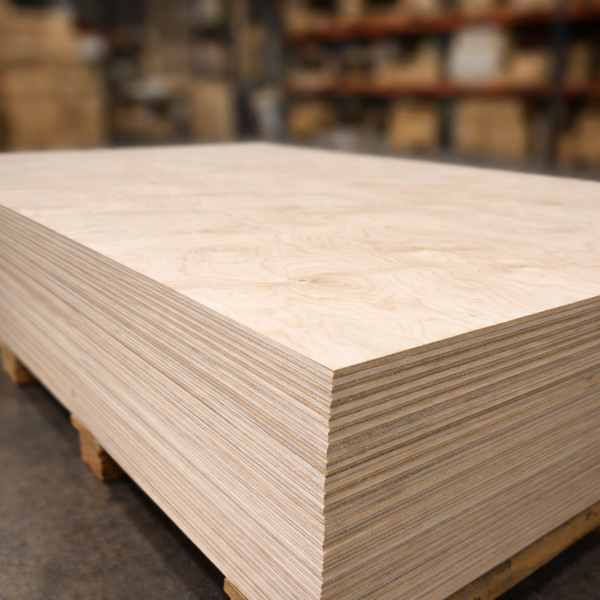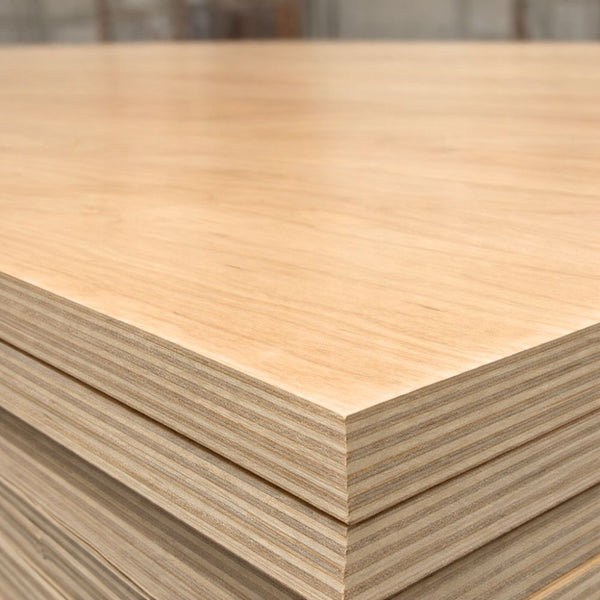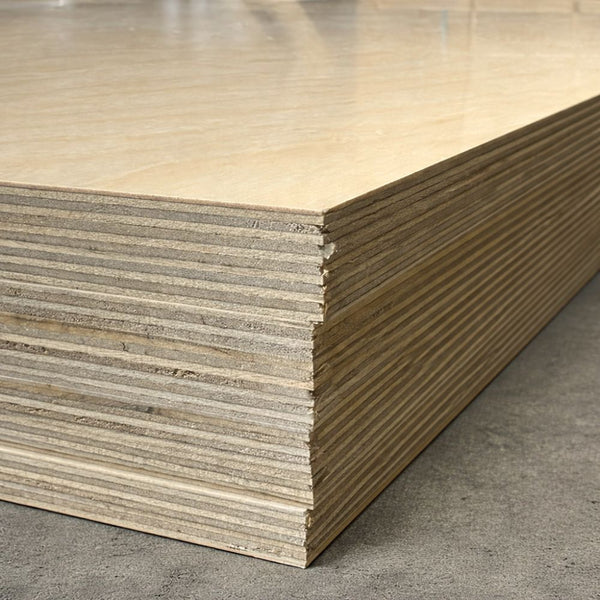

Quick answer
One-inch plywood exists, but a panel sold as “1 inch” should not be assumed to measure exactly 1.000 inch. The actual thickness depends on the manufacturer, panel standard, sanding, and construction. Before cutting dados, setting CNC depths, choosing edge banding, or matching hardware, confirm the supplier’s metric specification and measure the sheet you will use.
Berta’s current Baltic Birch range does not list an exact 1-inch option. Its thickest listed panel is 7/8 inch nominal, specified as 21 mm (about 0.827 inch). That can be useful for projects designed around 21 mm material, but it is not a drop-in replacement for a drawing that requires a true 1-inch panel.
What “1-inch plywood” can mean
The phrase may describe a nominal inch-based panel, a metric panel near that size, or a finished assembly built from more than one layer. Those are different products. A cabinet drawing may also use “1 inch” as a design dimension for a shelf nose, finished end, or countertop buildup rather than for one sheet.
Start with Berta’s actual-versus-nominal plywood thickness chart, then compare the supplier’s product data with your cut file. The companion plywood size and thickness guide explains why sheet dimensions and thickness labels should be treated as specifications, not assumptions.
Metric-to-inch values above are mathematical conversions, not promises about any unmeasured panel. Manufacturing tolerances and sanding can affect finished stock.
Thickness comparison for cabinet planning
| Thickness label | Metric reference | Difference from 1 inch | Typical planning consequence |
|---|---|---|---|
| 3/4 inch class | 18–19 mm is common in cabinet work | Roughly 6–7 mm thinner | Standard casework material, but not a substitute where a full-inch shoulder, groove, or finished dimension is specified. |
| 7/8 inch nominal | Berta lists its option as 21 mm | 4.4 mm / 0.173 in thinner | Extra-thick cabinet, shelf, furniture, or built-in parts designed for 21 mm stock. |
| 15/16 inch | 23.8 mm | 1.6 mm / 0.0625 in thinner | Close in name, but the difference still matters in captured panels and repeated openings. |
| True 1 inch | 25.4 mm | Reference dimension | Use when drawings, joinery, fasteners, or engineering assumptions explicitly require the full thickness. |
| Built-up assembly | Two bonded layers plus finish | Depends on measured components | Can achieve a design thickness, but changes edge treatment, weight, glue-up, machining, and flatness requirements. |
Where extra-thick plywood earns its keep
Long or heavily loaded shelves
Thickness can improve stiffness, but span, load, support spacing, grain direction, core quality, and edge reinforcement still control performance. Use the shelf material and sag-planning guide instead of choosing by thickness alone.
Furniture and exposed edges
A thick, multi-ply edge can be a deliberate visual detail. Confirm the face grade, core quality, and finishing plan before treating an exposed edge as a feature.
Jigs, fixtures, and built-ins
Extra thickness can provide bearing area and a substantial edge, but only if the fixture dimensions and fasteners are designed around the actual stock.
For ordinary cabinet boxes, thicker is not automatically better. It adds weight, cost, and machining depth. Review the cabinet plywood selection framework before changing a proven case construction.
A five-step substitution check
- Find every thickness-dependent dimension. Mark dados, rabbets, shelf pin setbacks, hinge plates, finished openings, drawer clearances, and edge-band widths.
- Convert once, then work in one unit system. One inch is 25.4 mm; 21 mm is approximately 0.827 inch.
- Measure representative sheets. Use calipers in several locations and record the range before programming tooling.
- Recalculate assemblies. Two side panels that are each 4.4 mm thinner enlarge an inside opening by 8.8 mm if the outside dimension stays fixed.
- Make a test joint. A short dado or edge sample is cheaper than correcting a production run.
If material weight affects unloading or installation, use Berta’s 4×8 plywood weight-planning method. For sheet quantity and cut layout, the sheet and cabinet project calculator provides a practical starting point, while the delivery-planning calculator helps frame logistics.
Current Berta option closest to one inch

BB/BB Baltic Birch plywood — 7/8 inch nominal / 21 mm
This is Berta’s current extra-thick Baltic Birch option. The product page lists a 4×8 sheet, BB/BB unfinished faces, a solid birch multi-ply core, and the 21 mm option as 15-ply. It suits projects designed around 21 mm stock.
Check before buying: 21 mm is approximately 0.827 inch—not a true inch. Confirm whether your design can absorb the 4.4 mm difference, and measure the delivered sheet before close-fitting joinery or CNC work.
Review the exact 21 mm Baltic Birch optionFor other constructions and finishes, compare the Baltic Birch collection, the prefinished plywood collection, and 4×8 prefinished cabinet plywood thicknesses. Do not infer that a listed 3/4-inch or 7/8-inch panel is a 1-inch product.
Common mistakes
- Entering 1.000 inch into a CNC file before measuring the actual panel.
- Calling 21 mm “close enough” without recalculating a captured opening.
- Using a thick panel to solve shelf sag while ignoring span and support.
- Laminating sheets without planning the glue line, edge treatment, clamping, and final flattening.
- Ordering by a search-result label instead of the current product specification.
Frequently asked questions
Does plywood come in a true 1-inch thickness?
Some suppliers offer panels in the 1-inch class, but availability and actual dimensions vary. Ask for the manufacturer’s metric thickness and tolerance, then measure the stock. Do not assume every “1 inch” listing is exactly 25.4 mm.
Is 7/8-inch plywood the same as 1-inch plywood?
No. Berta’s 7/8-inch nominal Baltic Birch option is listed as 21 mm, approximately 0.827 inch. A true inch is 25.4 mm, leaving a 4.4 mm difference.
Can I glue two sheets together to make 1-inch plywood?
A built-up panel can be designed to reach a target thickness, but it is an assembly, not a single 1-inch sheet. Account for glue, flatness, clamping pressure, weight, edge appearance, and the measured thickness of both components.
Should I use 1-inch plywood for cabinet boxes?
Usually not by default. Common cabinet construction often uses thinner panels because they are easier to source, machine, and handle. Use extra-thick material where the design, span, edge detail, or hardware actually benefits from it.
What should I send to a CNC shop?
Send the measured panel thickness, units, part geometry, joinery details, and acceptable tolerance. A nominal name alone is not enough for grooves, dados, or nested parts.
Bottom line
Treat “1-inch plywood” as a buying question and a dimensional-control question. Verify the exact panel, design to its measured thickness, and distinguish a true 25.4 mm requirement from a project that can use 21 mm or another standard size. That small discipline prevents loose dados, shifted openings, mismatched edges, and hardware conflicts.
Technical scope: Berta-specific specifications in this article were checked against the current BB/BB Baltic Birch product listing. Metric conversions are mathematical. Product availability and pricing can change; confirm the current product page before ordering.