
Quick answer
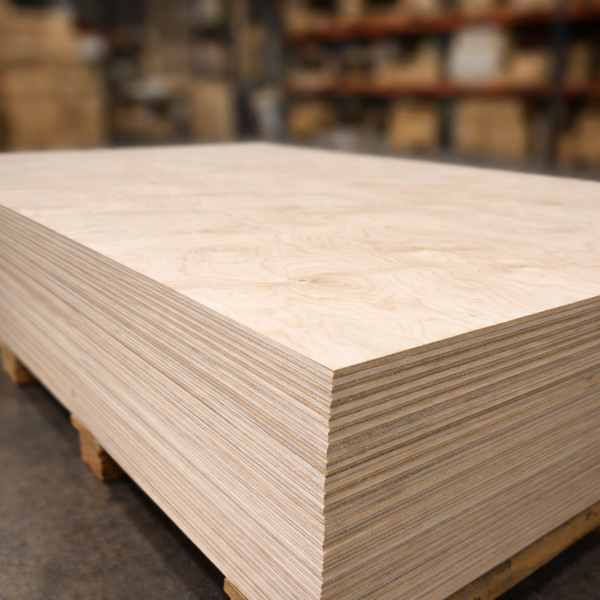
The most common plywood sheet size in the United States is 4 × 8 feet, or 48 × 96 inches. One full sheet covers 32 square feet before saw kerf, trimming, defects, and layout waste.
Plywood also comes in 5 × 5, 4 × 9, 4 × 10, 5 × 10, and specialty formats. Thickness varies separately from sheet length and width. Common cabinet thicknesses include 1/4, 1/2, and 3/4 inch, but the actual measurement may be slightly thinner or manufactured to a metric size such as 5, 12, or 18 mm.
What size does plywood come in?
Plywood sizes fall into two separate measurements: sheet length and width, then panel thickness. A “4 × 8 sheet” describes the face dimensions. A label such as 1/2 or 3/4 inch describes thickness.
For cabinets, closets, shelves, furniture, and interior millwork, 4 × 8 is the standard working format. Other sizes solve specific layout problems, such as reducing seams on tall panels or using traditional Baltic Birch formats for smaller components.
| Sheet size | Dimensions in inches | Gross coverage | Common use |
|---|---|---|---|
| 4 × 8 | 48 × 96 in | 32 sq ft | Cabinets, closets, shelving, walls, furniture, general sheet work. |
| 5 × 5 | 60 × 60 in | 25 sq ft | Traditional Baltic Birch format, drawer parts, furniture, jigs, smaller components. |
| 4 × 9 | 48 × 108 in | 36 sq ft | Tall panels, wall work, and layouts that benefit from fewer horizontal seams. |
| 4 × 10 | 48 × 120 in | 40 sq ft | Tall built-ins, doors, architectural panels, commercial millwork. |
| 5 × 10 | 60 × 120 in | 50 sq ft | Oversized panels, specialty fabrication, large faces, and yield-driven production. |
| Custom or project panel | Varies | Varies | Repairs, samples, craft work, small furniture parts, and cut-to-size orders. |
Best all-around format for cabinet shops, builders, closets, shelving, and furniture production.
Commonly associated with traditional Baltic Birch sheets and smaller precision parts.
Useful when a taller part can be cut without a seam, but harder to move and store.
How big is a 4 × 8 sheet of plywood?
A full 4 × 8 sheet is 4 feet wide and 8 feet long. In inches, it is 48 inches wide by 96 inches long. In gross surface area, it covers 32 square feet.
| Measurement | 4 × 8 plywood value | How it is used |
|---|---|---|
| Width | 4 ft / 48 in | The shorter sheet direction in a standard cabinet panel. |
| Length | 8 ft / 96 in | The longer sheet direction; face grain commonly runs this way on cabinet panels. |
| Gross area | 32 sq ft | Useful for early material estimates before waste and cut layout. |
| Perimeter | 24 linear ft | Useful only for full-sheet edge planning; cut parts require their own edge-band calculation. |
| Square inches | 4,608 sq in | Helpful when a cut list is built entirely in inches. |
Sheet-count formula: total project area ÷ 32 = the theoretical number of 4 × 8 sheets. Round up, then add waste for kerf, trimming, grain matching, defects, and awkward part sizes. Use the plywood and MDF sheet calculator for a faster estimate.
Is a 4 × 8 plywood sheet exactly 48 × 96 inches?
Many cabinet-grade panels are sold as full 48 × 96 inch sheets, but “4 × 8” should not be treated as a universal precision measurement. Imported metric panels, tongue-and-groove construction panels, specialty products, and cut-to-size sheets may measure differently.
Thickness varies even more than length and width. Before cutting cabinet parts, measure the actual sheet with a tape measure and calipers. This is especially important for dados, rabbets, drawer bottoms, fitted backs, CNC files, and repeated production.
| Panel example | Listed sheet size | Listed thicknesses | Planning note |
|---|---|---|---|
| Prefinished cabinet-grade plywood | 48 × 96 in | 3/4, 1/2, 1/4 in | Full-size 4 × 8 birch or white melamine cabinet panels. |
| Prefinished maple plywood | 48 × 96 in | 3/4 and 1/2 in | Full-size maple-faced cabinet panels with a factory finish. |
| BB/BB Baltic Birch plywood | 1220 × 2440 mm | 18, 12, and 5 mm | Approximately 48.03 × 96.06 in; check metric thickness before joinery. |
| Specialty or profiled panel | Varies by product | Varies | Coverage size can differ from overall size when edges are profiled. |
Common plywood thicknesses and actual dimensions
The number printed on a plywood label is often a nominal thickness. The actual panel may be slightly thinner after pressing and sanding, or it may be manufactured to a metric standard.
The table below shows common comparisons, not a guarantee for every hardwood or cabinet panel. Always check the product specification and measure the sheet you will machine.
| Nominal label | Common actual U.S. fraction | Common metric comparison | Typical cabinet use |
|---|---|---|---|
| 1/8 in | About 0.118 in | 3 mm | Templates, lightweight backs, craft parts, and curved work. |
| 3/16 in | About 0.1875 in | 5 mm is about 0.197 in | Drawer bottoms, backs, small panels, jigs, and lightweight parts. |
| 1/4 in | Often around 7/32 in | 6 mm is about 0.236 in | Cabinet backs, drawer bottoms, skins, inserts, and paneling. |
| 3/8 in | Often around 11/32 in | 9 mm is about 0.354 in | Light panels, some backs, underlayment, and specialty parts. |
| 1/2 in | Often around 15/32 in | 12 mm is about 0.472 in | Drawer parts, cabinet backs, smaller shelves, doors, and panels. |
| 5/8 in | Often around 19/32 in | 15 mm is about 0.591 in | Lighter cabinet boxes, drawer boxes, shelves, and partitions. |
| 3/4 in | Often around 23/32 in | 18 mm is about 0.709 in | Cabinet standard for boxes, shelves, furniture, and built-ins. |
| 1 in and thicker | Varies by product | 24–25 mm and above | Heavy shelves, work surfaces, specialty furniture, and laminated assemblies. |
For exact fractions, decimal inches, and millimeter conversions, use the nominal-to-actual plywood thickness chart.
Which plywood thickness should you use for cabinets?
Thickness should follow the part’s job. A cabinet back does not need the same panel as a pantry shelf. A tall frameless side needs more stiffness than a drawer bottom.
| Cabinet part | Common thickness | Why it works | What to verify |
|---|---|---|---|
| Cabinet sides | 3/4 in or 18 mm | Provides stiffness, screw holding, and room for joinery. | Actual thickness before cutting dados and fitting bottoms. |
| Cabinet tops and bottoms | 3/4 in or 18 mm | Keeps the case rigid and supports fasteners and hardware. | Match the side-panel thickness across the cabinet run. |
| Adjustable shelves | 3/4 in for most cabinet work | Better resistance to flex than thinner panels. | Span, load, shelf-pin support, and whether a front edge strip is needed. |
| Cabinet backs | 1/4 to 1/2 in | Reduces weight when the back is captured or otherwise supported. | Whether the back carries hanging or racking loads. |
| Drawer bottoms | 3/16 to 1/2 in | Thickness can be matched to drawer size and expected load. | Groove width, bottom span, and heavy contents. |
| Drawer sides | 1/2, 5/8, or project-specific | Keeps the drawer lighter while allowing strong joinery. | Slide clearances, joinery, and finished drawer dimensions. |
| Visible end panels | 1/4 skin or full 3/4 panel | Depends on whether the panel is decorative or structural. | Final cabinet width, door overlay, and grain alignment. |
4 × 8 vs 5 × 5 vs oversized plywood
A larger sheet is not automatically better. The right format depends on part size, seam placement, material handling, storage, saw capacity, delivery access, and yield.
| Format | Main advantage | Main limitation | Best fit |
|---|---|---|---|
| 4 × 8 | Widely available and compatible with common cabinet layouts and shop equipment. | May require seams or multiple sheets for oversized faces. | Most cabinet projects |
| 5 × 5 | Convenient square format for many Baltic Birch parts and smaller components. | Only 25 sq ft and too short for many full-height cabinet parts. | Drawers, furniture, jigs, small panels, and precision work. |
| 4 × 9 or 4 × 10 | Can eliminate seams on taller walls, panels, and built-ins. | Harder to source, carry, store, cut, and deliver. | Tall architectural panels and commercial millwork. |
| 5 × 10 | More layout area and potentially better yield on large parts. | Requires suitable equipment and handling space. | Production shops, large doors, wall panels, and specialty fabrication. |
Sheet size, grain direction, and cut planning
Square footage is only a rough estimate. Cabinet parts must also fit the sheet in the correct orientation. Grain direction, saw kerf, trimming, defects, and repeated dimensions can turn a 32-square-foot sheet into far less usable yield.
Enter finished part dimensions, quantities, kerf, and waste in the plywood cut-list calculator before placing a full-sheet order.
How many 4 × 8 plywood sheets do you need?
Use square footage only for the first estimate. Divide the project area by 32, round up to a full sheet, then add a realistic waste allowance. Cabinet work often needs more waste than a simple wall because parts must follow grain direction and fit around repeated dimensions.
| Number of 4 × 8 sheets | Gross coverage | Planning note |
|---|---|---|
| 1 sheet | 32 sq ft | Enough only when the required parts fit the sheet layout. |
| 2 sheets | 64 sq ft | Useful for small built-ins, repairs, and compact cabinet work. |
| 5 sheets | 160 sq ft | Plan kerf, trimming, face selection, and a possible spare. |
| 10 sheets | 320 sq ft | Check cut-list yield before assuming all gross area is usable. |
| 25 sheets | 800 sq ft | Large shop order; coordinate handling, storage, and consistent material. |
| 50 sheets | 1,600 sq ft | Production-scale order; finalize yield and delivery planning before purchase. |
Choose plywood size by project
| Project | Common sheet format | Common thickness direction | What matters most |
|---|---|---|---|
| Kitchen cabinet boxes | 4 × 8 | 3/4 in or 18 mm | Flatness, core quality, hardware holding, and repeatable thickness. |
| Closet systems | 4 × 8; oversize where available for tall continuous panels | 3/4 in for verticals and shelves | Panel height, shelf span, surface finish, and edge banding. |
| Drawer boxes | 4 × 8 or 5 × 5 | 1/2, 5/8, or design-specific | Clean machining, actual thickness, slide clearance, and strong edges. |
| Furniture cases | 4 × 8 or specialty size | 1/2 to 3/4 in | Visible face, grain direction, weight, and joinery. |
| Wall panels and tall built-ins | 4 × 8, 4 × 9, 4 × 10, or 5 × 10 | Depends on substrate and mounting | Seam location, handling, elevator access, and installation space. |
| Cabinet backs and inserts | 4 × 8 or cut-to-size | 1/4 to 1/2 in | Whether the panel is structural, captured, finished, or visible. |
Compare Berta Store 4 × 8 plywood options
Berta Store focuses on full-size cabinet panels. These three products use similar face dimensions but differ in surface, core, finish, and thickness range.

4 × 8 prefinished cabinet-grade plywood
Choose a natural birch UV finish or white melamine surface for cabinet boxes, closets, shelving, furniture, built-ins, and finished interiors.

Prefinished maple plywood 4 × 8
A cabinet-grade maple panel with a factory UV-cured clear finish for visible interiors, furniture, shelves, closets, and built-ins.

Baltic Birch BB/BB 4 × 8 plywood
Smooth unfinished faces and a solid birch core for cabinet boxes, drawer boxes, shelves, furniture, CNC work, jigs, and painted parts.
To compare more surfaces and cores, browse the cabinet-grade plywood collection, the prefinished plywood collection, or the full Baltic Birch plywood collection.
What to check before ordering plywood sheets
Confirm the exact sheet dimensions
Verify feet, inches, or millimeters. Do not assume every product described as 4 × 8 uses identical manufacturing dimensions.
Confirm actual thickness
Check the specification, then measure a sample sheet before preparing dados, grooves, CNC files, or repeated joinery.
Match thickness to the cabinet part
Use thicker panels for boxes and wide shelves. Use thinner panels only where backs, drawer bottoms, inserts, and skins are properly supported.
Plan grain direction and visible faces
Lay out doors, end panels, shelves, and furniture parts so the grain runs consistently and the best face remains visible.
Check equipment and delivery access
Full and oversized sheets require suitable saw capacity, storage, loading access, and safe handling.
Add realistic waste
Include kerf, trimming, defects, grain matching, offcuts, and one spare sheet when a schedule cannot absorb a reorder.
FAQ
What size does plywood come in?
The most common full sheet is 4 × 8 feet, or 48 × 96 inches. Other available formats can include 5 × 5, 4 × 9, 4 × 10, 5 × 10, project panels, and custom sizes.
What sizes does plywood come in for cabinets?
Cabinet shops commonly use 4 × 8 sheets because they work well for boxes, shelves, doors, backs, closets, and furniture parts. Oversized panels may be used for tall built-ins or large faces when handling equipment and availability allow.
How big are sheets of plywood?
A standard full sheet is 4 feet wide by 8 feet long. That equals 48 × 96 inches and 32 square feet before cutting waste.
Is a 4 × 8 plywood sheet exactly 48 × 96 inches?
Many cabinet panels are listed at a full 48 × 96 inches, but dimensions vary by manufacturer and panel type. Imported metric sheets, profiled panels, and specialty products may differ slightly.
How many square feet are in a 4 × 8 sheet?
One 4 × 8 sheet has 32 square feet of gross area. The usable yield is lower after saw kerf, trimming, grain layout, defects, and offcuts.
Can you buy plywood larger than 4 × 8?
Yes. Some products are made in 4 × 9, 4 × 10, 5 × 10, and other specialty formats. Availability depends on species, core, grade, finish, supplier, and region.
What are the most common plywood thicknesses?
For cabinet and furniture work, 1/4, 1/2, and 3/4 inch are common. Baltic Birch and imported panels are also sold in metric thicknesses such as 5, 12, and 18 mm.
Is 3/4 plywood actually 3/4 inch thick?
Not always. Some nominal 3/4 plywood measures around 23/32 inch, and an 18 mm panel measures about 0.709 inch. Other products may be listed as a true 0.75 inch. Measure the actual sheet before cutting joinery.
What size is Baltic Birch plywood?
Baltic Birch is traditionally associated with 5 × 5 sheets, but full 4 × 8 sheets are also available. Berta Store’s BB/BB Baltic Birch measures 1220 × 2440 mm and comes in 18, 12, and 5 mm thicknesses.
Which way does plywood grain run?
On many veneer-faced cabinet sheets, the visible long grain runs parallel to the long sheet dimension. Confirm the product before planning visible parts because face-grain direction affects cabinet appearance and cut yield.
What plywood size is best for cabinet boxes?
A full 4 × 8 panel in 3/4 inch or 18 mm is the common starting point for cabinet sides, tops, bottoms, shelves, and partitions. The best product still depends on core quality, finish, joinery, and actual dimensions.
Bottom line
The standard plywood sheet is 4 × 8 feet, or 48 × 96 inches, with 32 square feet of gross area. Other formats—including 5 × 5 and oversized panels—are useful when part size, seam placement, or production yield calls for them.
Length and width are only half the specification. Check actual thickness, metric conversions, face grain, core, finish, and usable cut layout before ordering. A panel labeled 3/4 inch may measure 23/32, 18 mm, or a product-specific true thickness.
Start with Berta Store’s cabinet-grade 4 × 8 plywood sheets, compare factory-finished plywood panels, or choose Baltic Birch plywood when a strong birch core and clean machining matter.