
Receiving sheet goods
Quick answer
A successful plywood delivery is planned from the curb or loading area backward. Before the truck arrives, confirm the delivery route, truck access, ground-level unloading location, receiver availability and equipment needed for the order size. Freight carriers schedule a delivery window; the receiver should be ready to inspect the shipment before it is moved or unwrapped.
Berta Store’s current freight information describes ground-level delivery and asks customers to request a lift gate in advance when needed. Carriers do not move plywood into garages, basements or interiors. Regional availability, charges and timing can change, so use the current delivery page and calculator rather than an old price or transit-time quote.
Choose the route
Regional delivery, freight or pickup?
The right route depends on destination, order size, site access and the services confirmed for the order. Start with the current plywood and MDF delivery coverage and the delivery calculator. For shipments beyond the regional service area, review the nationwide freight process before placing the order.
| Route | Useful for | Confirm before ordering | Prepare before arrival |
|---|---|---|---|
| Regional delivery | Eligible destinations within the current Berta service area | Address eligibility, order threshold or fee, expected contact method and unloading responsibilities | Legal truck access, a receiver, a clear ground-level set-down area and a plan to move sheets under cover |
| Common-carrier freight | Qualifying palletized shipments outside the regional route | Commercial or residential site, appointment process, lift-gate need, pallet dimensions and site restrictions | Receiver during the window, room for the truck, ground-level access and equipment or labor appropriate to the load |
| Pickup | Customers with a suitable vehicle, load restraint and handling plan | Pickup location, order readiness, vehicle bed/deck size, legal payload and weather protection | Straps, edge protection, a flat support surface and a safe unloading team at the destination |
| Custom/bulk planning | Large quantities, mixed materials or jobs needing a quoted configuration | Exact SKUs, quantities, destination, access notes and requested timing | A documented receiving plan sized to the confirmed pallets and vehicle |
Do not assume a lift gate solves every site problem. A lift gate can help lower a shipment to ground level when it is confirmed for the load and carrier. It does not create turning space, remove a pallet from a soft or sloped surface, or move sheet goods inside the building.
Site survey
Check the last 100 feet before the order ships
Truck approach
Look for low branches and wires, narrow gates, weight restrictions, tight turns, cul-de-sacs, loading-zone rules and cars that can block the approach. Share material access limitations before dispatch—not when the truck is outside.
Ground condition
A pallet jack needs a hard, reasonably level surface. Gravel, lawns, steep driveways, curbs and broken pavement can stop a pallet even after it reaches ground level.
Protected storage
Prepare a flat, dry support area before delivery. Keep panels off damp concrete and protect faces, corners and edges while the load is moved and staged.
Estimate the physical load with the plywood pallet calculator. Then compare that plan with the sheets-per-bundle reference and the plywood weight chart. Calculated weights are planning estimates; the confirmed shipment and carrier requirements control.
Receiving workflow
From appointment call to protected storage
Material planning
Panel choices that often ship by pallet

3/4-inch Birch prefinished plywood
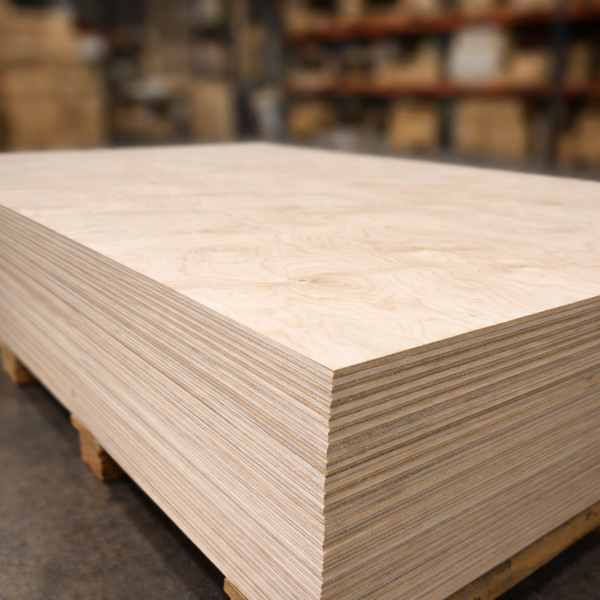
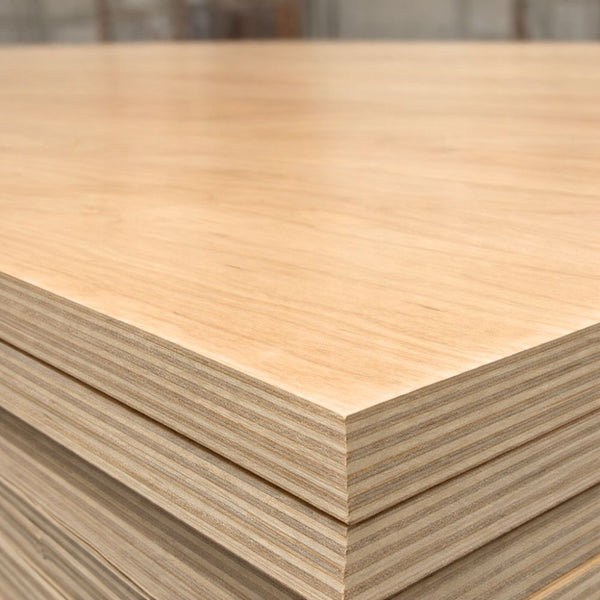
The current 4×8 panel is listed with a multi-ply poplar core and Birch UV finish on both sides at the 3/4-inch thickness. For a multi-sheet order, confirm quantity, pallet configuration and delivery route before scheduling labor or equipment.
Review prefinished plywood options
3/4-inch Baltic Birch BB/BB
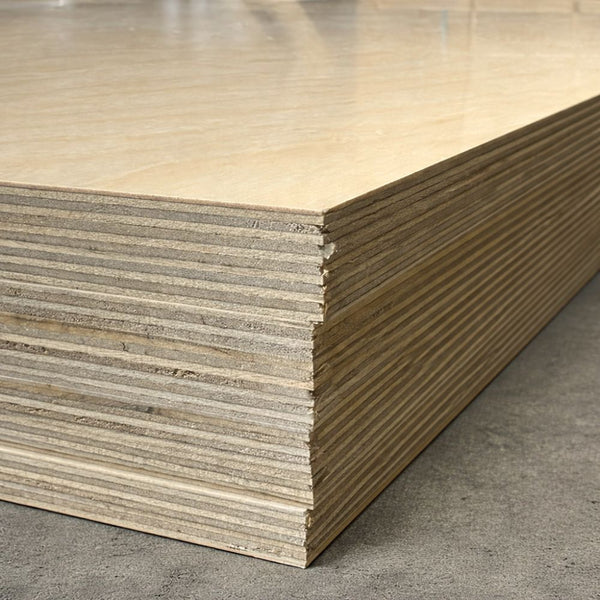
The current 4×8 panel is listed as unfinished BB/BB with a solid birch core. Sheet count and panel weight compound quickly, so use the confirmed order rather than a generic bundle assumption when planning the receiving crew.
Review the 3/4-inch Baltic Birch optionTroubleshooting
Common delivery problems and the better response
| Problem | Why it matters | Better preparation |
|---|---|---|
| The truck cannot reach the site | A confirmed delivery does not override physical or legal access limits. | Disclose restrictions early and identify a safe alternative receiving point for approval. |
| No receiver is available | The shipment cannot be inspected or directed, and redelivery consequences may apply. | Assign a named receiver with the order details and authority to document exceptions. |
| The pallet is on gravel or a slope | Standard pallet-handling equipment may not travel safely. | Prepare a hard, level transfer area and confirm how the load will move from the truck. |
| Damage is noticed after dispersing the load | It becomes harder to document shipment condition and affected counts. | Photograph wrap, corners and visible faces before breaking down the pallet; keep packaging and records while the issue is reviewed. |
| Sheets are left exposed | Moisture and unsupported storage can damage faces and edges or introduce distortion. | Move panels promptly to a dry, flat, supported storage location. |
For cut planning after receipt, review the plywood kerf allowance reference before assuming every square inch of a 4×8 sheet becomes usable parts.
Frequently asked questions
Plywood delivery questions
Does plywood freight delivery include moving panels inside?
No. Berta Store’s current freight information describes ground-level delivery and states that carriers do not unload into garages, basements or interior spaces. Confirm the service level for the order and prepare a separate on-site handling plan.
Do I need a lift gate?
You may need one when the receiving site does not have a dock or suitable forklift and the carrier can provide a compatible lift-gate service. Request it in advance and confirm that the load size and site allow its use.
Can a pallet jack roll across a driveway or yard?
It generally needs a hard, reasonably level surface. Gravel, grass, curbs, steep slopes and rough pavement can prevent safe movement. Evaluate the exact route and equipment before arrival.
What should I photograph at delivery?
Capture the full load on the truck or at set-down, all sides of the packaging, straps and corner protection, labels, visible sheet edges and any puncture, crushing or moisture. Keep the original files with the order documentation.
How do I get a current delivery quote?
Use the current delivery calculator for supported routes or submit a custom invoice request with the material, quantity, destination and access notes. Do not rely on an older article or product-description price.
Current resources
Confirm the order-specific details
- regional plywood and MDF delivery information
- nationwide freight delivery process
- current delivery calculator
- post-order workflow
- current shipping policy
- Berta Store order support
- current plywood collection