
Quick answer
Use 3/4-inch plywood for cabinet sides, bottoms, tops, partitions and shelves when stiffness, screw length and load capacity matter. Use 1/2-inch plywood for lighter components, selected drawer parts, certain backs and weight-sensitive assemblies that are properly supported.
Thickness alone does not decide performance. Core construction, face quality, grain direction, span, load, joinery and edge support all matter. Measure the actual sheet before machining: Berta’s current cabinet-grade options are listed as 12 mm for 1/2 inch and 18 mm for 3/4 inch.
Where each thickness belongs
| Cabinet part | Typical starting point | Why | Design checks |
|---|---|---|---|
| Base or wall cabinet side | 3/4 inch | Stiffer case, more edge area for joinery and common hardware assumptions. | Core, dado depth, fastener length, exposed edge. |
| Cabinet bottom or top | 3/4 inch | Better resistance to bending between supported edges. | Span, appliance or countertop loads, joinery. |
| Fixed partition | 3/4 inch | Supports shelves, drawers and face-frame or frameless geometry. | Hardware clearances and shelf-pin layout. |
| Adjustable shelf | 3/4 inch | More stiffness for a given material and span. | Span, anticipated load, edge treatment, core quality. |
| Drawer side or subcomponent | 1/2 inch can fit | Saves interior space and weight in designs built for it. | Slide system, bottom groove, drawer dimensions, load. |
| Structural cabinet back | 1/2 inch can fit | Can square and reinforce a case when fully integrated. | Back groove, nailer location, hanging method. |
| Applied end or skin | Neither by default | A thinner decorative panel may be more efficient because the case supplies structure. | Finish, adhesive, reveal and edge coverage. |
Why 3/4-inch plywood usually feels much stiffer
For otherwise similar panels, bending stiffness increases strongly with thickness; it is not a simple one-to-one change. Real plywood performance also depends on veneer species, ply construction, defects, face orientation and how the part is supported. That is why a direct material substitution should be tested rather than assumed.
3/4 inch gives more section depth
That generally improves resistance to bending in cabinet sides and shelves. It also leaves more edge area for screws, confirmats, dowels and other joinery.
1/2 inch reduces mass and consumes less space
It can be valuable in drawer parts, reinforced backs and transport-sensitive assemblies, provided the cabinet design replaces the stiffness it gives up.
Do not transfer structural load values from one manufacturer or grade to another. For engineering design, use the exact panel’s published properties.
Choose by load path, not habit
Identify the part
Is it a side, shelf, back, drawer part or decorative skin? Each role asks something different of the panel.
Map span and support
Record unsupported distance, edge support, fixed versus adjustable conditions and expected contents.
Check the system
Confirm joinery, fastener length, hardware clearances and the actual measured material before releasing a cut list.
Use the cabinet box estimator to establish case-part quantities, the plywood cut-list calculator to plan sheets, and the plywood thickness calculator to compare labels. The general plywood and MDF calculator helps with sheet planning, and the delivery calculator supports logistics.
Thickness is only one line on the specification
Core
Multi-ply cores, veneer cores and other constructions differ in edge appearance, machining and fastener behavior. Inspect the exact product.
Face and finish
Unfinished birch, UV-prefinished birch and white melamine solve different visual and fabrication needs.
Actual dimension
The Berta products discussed below list 12 mm and 18 mm. Design dados, reveal stacks and hardware clearances from actual stock.
Grain and orientation
Panel strength and appearance can vary by direction. Keep the face grain and the part’s principal span in the plan.
For supporting detail, use the 1/2-inch plywood cabinet-use guide, the actual plywood thickness chart, and Berta’s cabinet plywood selection guide. Drawer builders should also check the drawer-box thickness and slide-compatibility chart.
Compare the exact 1/2- and 3/4-inch variants

1/2-inch (12 mm) birch prefinished plywood
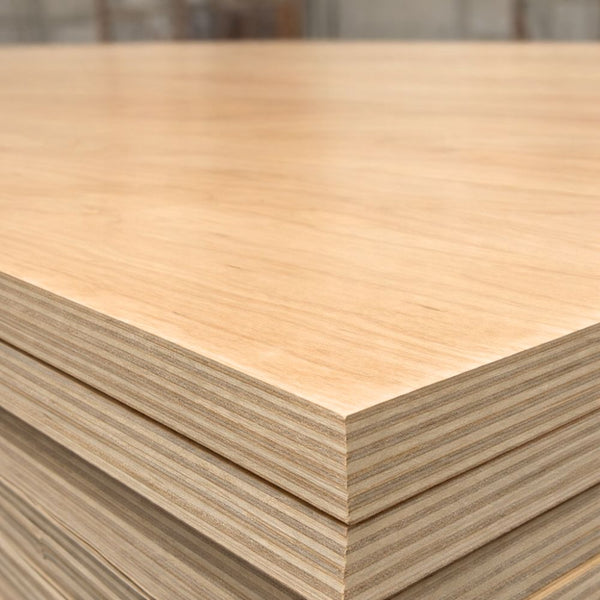
Multi-ply poplar core, natural birch veneer and UV-cured clear finish. The current listing specifies finished faces on both sides for this thickness.
Check: support, measured thickness, joinery and whether 12 mm works with your hardware.
View the verified 1/2-inch variant
3/4-inch (18 mm) birch prefinished plywood
The same current product family in a thicker 18 mm panel, with birch veneer, UV-cured clear finish and both faces finished.
Check: load, span, edge treatment, fastener length and cabinet-system assumptions.
View the verified 3/4-inch variant
1/2-inch (12 mm) BB/BB Baltic birch
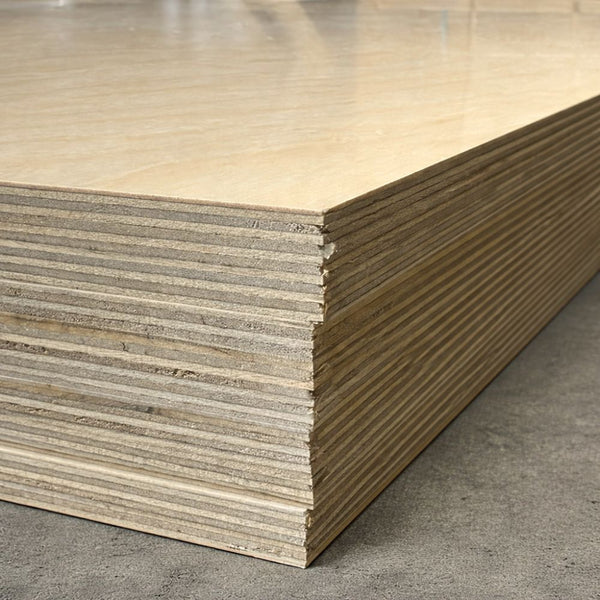
Unfinished birch faces, a solid birch core and sanded surfaces suit projects that need machining, exposed edges or a custom finish.
Check: BB/BB face expectations, finish plan and the 12 mm dimension.
View the verified 1/2-inch Baltic birch variant
3/4-inch (18 mm) BB/BB Baltic birch
The current listing specifies a 13-ply solid birch panel with unfinished BB/BB faces, sanded on both sides.
Check: grade patches, finish plan, measured thickness and edge appearance.
View the verified 3/4-inch Baltic birch variantWhen a thickness choice causes problems
| Symptom | Likely planning issue | Correction |
|---|---|---|
| Shelf sags | Span or load exceeds the design; material too flexible. | Shorten the span, add a stiffener/support or redesign with a suitable panel. |
| Dados fit loosely | Nominal dimension used as cutter size. | Measure stock and make a test cut. |
| Screw breaks through a face | Fastener length carried over from thicker material. | Recalculate fastener length and pilot requirements for the exact panel. |
| Drawer hardware collides | Side thickness changed without updating inside dimensions. | Rebuild the clearance stack from the hardware instructions. |
| Case racks during handling | Reduced panel thickness without compensating back/joinery support. | Improve the back, joinery or bracing; do not rely on thickness labels alone. |
1/2- vs 3/4-inch plywood questions
Can I build an entire cabinet from 1/2-inch plywood?
Possible designs exist, but they require joinery, support, hardware and loads engineered around the thinner material. It is not a drop-in substitute for a cabinet designed around 3/4-inch panels.
Is 18 mm plywood exactly 3/4 inch?
No. Eighteen millimeters is about 0.709 inch. Use the listed metric dimension and measure the sheet for precision work.
Which is better for shelves?
For otherwise similar panels and the same span, 3/4 inch is the safer starting point because it is stiffer. Still check load, core construction, span and edge support.
Does 1/2-inch plywood save useful weight?
Yes, but the exact difference depends on species, core and moisture. Use the plywood weight chart as a planning aid and verify the exact product if handling limits are critical.
Should cabinet backs be 1/2 or 3/4 inch?
Many integrated backs can use 1/2 inch, while specialized hanging, fastening or construction systems may require something different. Follow the cabinet design and hanging method.
Technical basis
- APA plywood selection and specification for grade, orientation and design-property context.
- APA panel thickness tolerances and labeling for nominal and performance-category context.
- Berta variant dimensions, construction, finish and exact product imagery were checked October 28, 2026.
The cabinet-part recommendations are practical starting points. Confirm engineered loads, hardware instructions and local code requirements for the actual build.