
Quick answer
Buying plywood cut to size works best when the order defines the finished part, not just a list of rough dimensions. Specify the panel, thickness, face orientation, finished length and width, quantity, edge condition, acceptable tolerance, and which side must stay clean. Ask the supplier to confirm the cutting method, measurement convention, and whether the quoted dimensions are finished sizes.
Precut panels can reduce handling and shop time, but they do not remove the need for a cut list. A service cannot infer grain direction, visible faces, edge-banding allowances, hardware clearances, or how a part fits the rest of the cabinet.
What a cut-to-size plywood order must say
Start with the same information you would place on a controlled shop drawing. “Two 24-inch pieces” is ambiguous. It does not say which sheet is being cut, whether 24 inches is a finished dimension, which direction the face grain runs, which face is visible, or whether an edge will receive banding.
| Order field | What to record | Why it changes the part | Question to confirm |
|---|---|---|---|
| Panel identity | Exact product, species, core, grade, finish and thickness | Two “birch plywood” sheets can have different cores, faces and coatings | Will the cut parts come from the exact panel and variant approved? |
| Finished size | Length × width, units and quantity | Reversing dimensions can rotate grain or change the nesting plan | Are dimensions read as finished sizes after the saw cut? |
| Grain direction | Arrow or note tied to the first dimension | Visible cabinet parts look inconsistent when orientation changes | Does “length” follow the face grain on every part? |
| Face designation | Show face, back face and finished-face count | A finished or higher-grade face needs protection and the correct saw orientation | How will the show face be marked and protected? |
| Tolerance | Acceptable plus/minus range and squareness requirement | A tolerance suitable for wall panels may be unsuitable for doors or drawer parts | Is the quoted tolerance typical, or guaranteed for this order? |
| Edge condition | Sawn, machined, sanded, banded or left oversize | A clean-looking edge is not automatically ready for glue, banding or joinery | Are chipped, open or compressed edges rejected? |
| Downstream work | Dadoes, hinge cups, slide clearances, banding or final trimming | Later operations may need stock, reference edges or machining allowance | Should parts be delivered finished-size or intentionally oversize? |
Tolerance, kerf and squareness are different checks
Kerf is the material removed by the blade. It matters when laying parts onto a sheet. Dimensional tolerance is the allowed difference between the requested and delivered part size. Squareness describes the relationship between adjacent edges. A part can be the right length and width yet still be out of square.
Berta’s plywood kerf allowance reference explains why the layout must reserve blade width. Use the plywood cut-list calculator for sheets, waste and cut planning before requesting a quote, then tell the cutting service which dimensions are critical.
Write grain and face direction into the cut list
For visible cabinet work, orientation is a design rule. Mark grain direction on each appearance part and define how it relates to the dimensions. A practical convention is “length follows grain,” but the convention only works if the supplier receives it in writing.
Factory-finished panels add another face decision. Berta’s current 3/4-inch and 1/2-inch prefinished plywood listings describe both faces as finished, while the current 1/4-inch option is listed with one finished face. That distinction changes labeling, protection and the orientation of some parts. Confirm the exact variant on the product page before ordering.
- Use a grain arrow on every visible part.
- Label pairs and sequences that must match.
- Identify the show face and the reference edge.
- State whether edge banding is included in finished size.
- Keep part IDs on offcuts until assembly is complete.
- Separate rough blanks from finished parts.
- Record units once and use them consistently.
- Do not infer actual thickness from a nominal label.
How to inspect precut plywood when it arrives
Inspect before parts are mixed into production. The first review should answer five questions: Is this the approved panel? Are the dimensions correct? Are adjacent edges square? Is the intended face clean? Are exposed edges acceptable for the next operation?
| Check | Simple method | Possible problem | Action before fabrication |
|---|---|---|---|
| Panel match | Compare label, face, finish, thickness and approved sample | Wrong variant or mixed material | Quarantine the parts and verify the order record |
| Length and width | Measure several parts with the same tool and method | Systematic offset or inconsistent cuts | Compare with the stated tolerance; do not average away a bad part |
| Squareness | Compare diagonals or use a verified square | Parallelogram parts that resist assembly | Identify whether re-trimming preserves the required finished size |
| Face quality | Inspect under raking light | Chips, scratches, pressure marks or finish damage | Separate show-face rejects before banding or assembly |
| Edge quality | Inspect the full perimeter and make a test band or joint | Tear-out, open core gaps or an edge unsuitable for the next process | Decide whether machining, filling, re-cutting or rejection is appropriate |
APA’s published cutting guidance recommends supporting panels, selecting the appropriate saw orientation, using fine teeth, and using backing or tape where needed to reduce chipping. Those practices help, but they do not establish a universal tolerance for every supplier or panel.
Start with a panel that matches the finished part
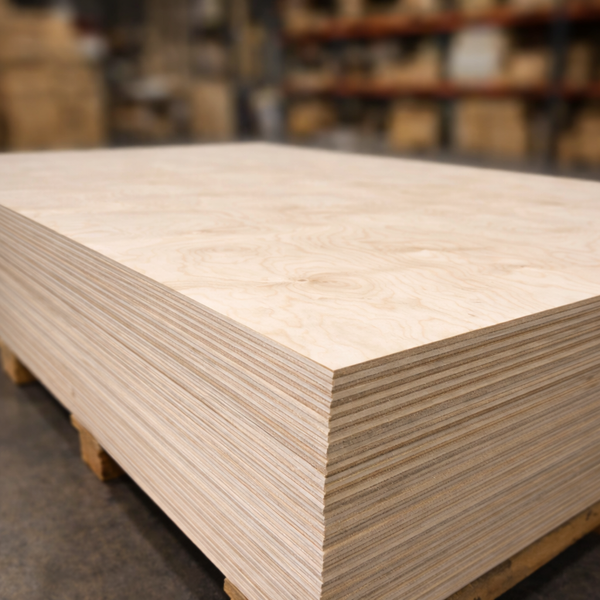
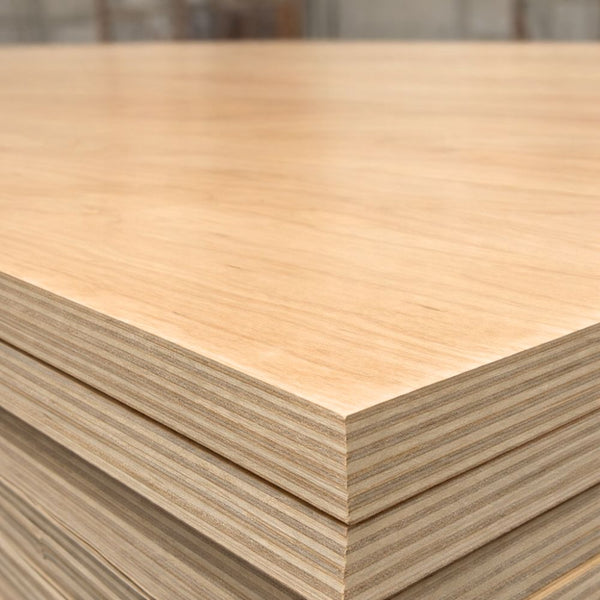
The cutting method cannot correct a mismatched material specification. These current Berta panels serve different needs; the exact thickness image and product details below were checked for this draft.

3/4-inch prefinished birch plywood
A practical starting point for cabinet interiors and parts where a factory-finished birch face can reduce finishing labor. The current listing describes a 4×8 multipoplar-core panel finished on both faces at this thickness.
Check before ordering: exact thickness, finish, face direction, machining allowances and whether the cut service protects both faces.
Review the 3/4-inch prefinished plywood
3/4-inch BB/BB Baltic Birch
A useful candidate when an unfinished birch face, multi-ply edge and consistent cabinet panel are part of the design. Berta’s current listing describes a 4×8, BB/BB, unfinished, solid-birch panel.
Check before ordering: grade expectations, actual thickness, edge exposure, finish plan and long-grain orientation.
Review the 3/4-inch BB/BB panelPlan before requesting cuts
Use Berta’s free plywood and MDF calculator for a quantity estimate, check the plywood thickness planning tool, and review plywood and MDF delivery coverage if full sheets are the better fit.
The current Berta product pages sell full panel specifications; this article does not state that Berta offers custom cutting.
Review plywood buying questionsSix mistakes that turn precut parts into rework
- Ordering by species name alone. A species does not define the core, face grade, finish, bond or actual thickness.
- Leaving grain direction implicit. A nested layout may rotate parts to save material unless orientation is a written rule.
- Using nominal sheet dimensions as usable area. Kerf, trim, defects and alignment consume material.
- Confusing cut quality with edge readiness. A sawn edge may still need machining, sanding, filling or banding.
- Applying one tolerance to every component. Rough shelves, door blanks and joinery-ready parts do not have the same fit requirement.
- Skipping the first-article check. Repeating an unverified part multiplies the error.
For sheet-size context, use Berta’s standard plywood sheet-size reference. For yield planning, compare the 4×8 plywood piece-count examples and the actual-versus-nominal plywood thickness chart.
Plywood cut-to-size questions
Does cut to size mean the part is ready to install?
No. Confirm whether the service supplies a rough blank, a finished-size rectangle, a machined part or a fully edge-finished component. Hardware boring, dados, edge banding, sanding and finish protection may remain.
Should plywood be cut exactly to the drawing dimension?
Only if the drawing dimension represents the finished part and no later process requires allowance. Edge banding, joinery, trimming and field fitting can change the required blank size.
How should grain direction be written?
Use an arrow or a clear note such as “first dimension follows face grain.” Apply the same convention to every appearance part and include it in the approved cut list.
Can I assume a 3/4-inch panel is exactly 0.750 inch thick?
No. Treat the label as nominal unless the exact product documentation states otherwise. Measure the material lot before sizing grooves, dados or hardware locations.
What should I ask before buying precut plywood online?
Ask for the exact panel identity, cutting method, dimensional and squareness tolerance, face-protection method, edge standard, labeling process, damage procedure and whether finished dimensions are guaranteed.
Does Berta Store offer custom plywood cutting?
This article does not make that claim. Use Berta’s current product and support pages to confirm available ordering and delivery options; do not assume a cutting service from the presence of a cut-list calculator.
Specify the part before buying the service
A strong cut-to-size order is a compact production document: exact panel, finished dimensions, grain and face direction, tolerance, edge expectation, quantity and approval method. That information lets a supplier quote the right work and lets you judge the result without improvising at receiving.
Verified Berta resources used in this plan
- Plywood cut-list calculator for sheet layouts and waste
- Plywood and MDF quantity calculator
- Plywood thickness planning tool
- Plywood and MDF delivery service information
- Plywood grades, thicknesses and delivery FAQ
Technical scope: General cutting practices were checked against APA’s published building hints. Product-specific claims reflect the Berta product pages reviewed for this draft. Cutting tolerances, service availability and final dimensions must be confirmed with the selected provider.