
On paper, 3/4-inch birch plywood in a 4x8 sheet looks like a universal solution. It’s thick, flat, easy to source, and familiar to most shops. In practice, it’s one of the most commonly misused panels in cabinetry and interior work.
Professionals don’t struggle because the material is bad. They struggle because “3/4 birch plywood” covers a wide range of constructions, cores, and performance levels. Knowing which version you’re actually buying—and what it’s suited for—matters more than the thickness itself.
What is 3/4 birch plywood 4x8?
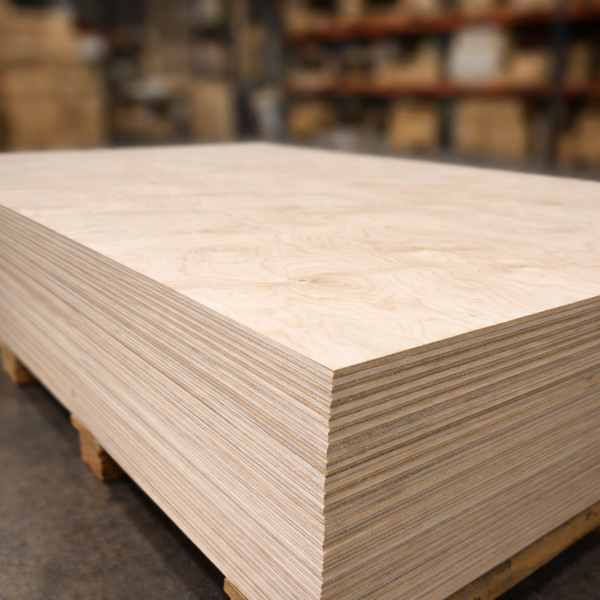
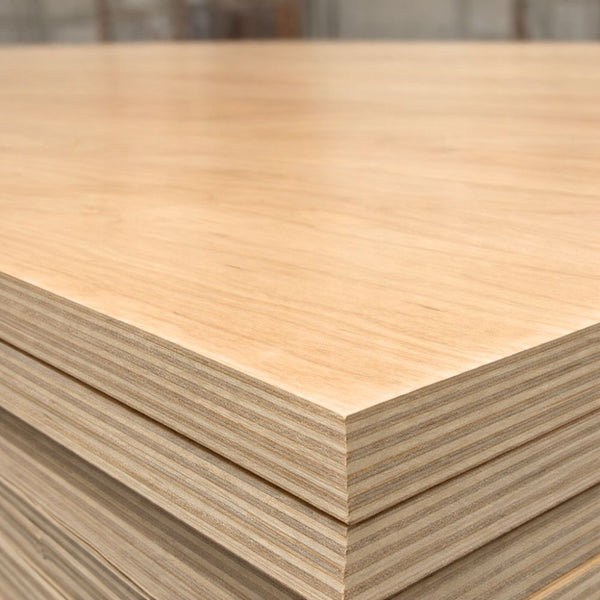
3/4 birch plywood 4x8 is a cabinet-grade hardwood plywood sheet measuring 48 by 96 inches. It is typically built with a veneer or combination core and birch face veneers, making it suitable for cabinet boxes, shelving, and interior furniture panels.
3/4 Birch Plywood 4x8 Sheet Specifications
| Specification | Typical Value |
|---|---|
| Sheet Size | 4 × 8 ft (48 × 96 in) |
| Nominal Thickness | 3/4 in |
| Actual Thickness | 18–19 mm depending on manufacturer |
| Face Veneer | Birch |
| Common Core Types | Veneer core or combination core |
| Typical Uses | Cabinet boxes, shelving, furniture panels |
What 3/4 Birch Plywood 4x8 Is Actually Used For
This panel is primarily an interior sheet good. In professional shops, it’s used where flatness, machinability, and a paint- or clear-finishable surface are required.
Typical uses for 3/4 birch plywood 4x8 include:
- Cabinet carcasses and box construction
- Shelving with proper span support
- Built-ins, closets, and wall units
- Furniture components where edges are covered or banded
In these roles, the panel works because thickness provides stiffness, and birch faces provide a clean, predictable surface for finishing.
How Professionals Evaluate This Panel
Experienced buyers don’t start with thickness. They start with construction.
Core construction
The core determines screw holding, edge durability, and long-term flatness. Birch plywood may use:
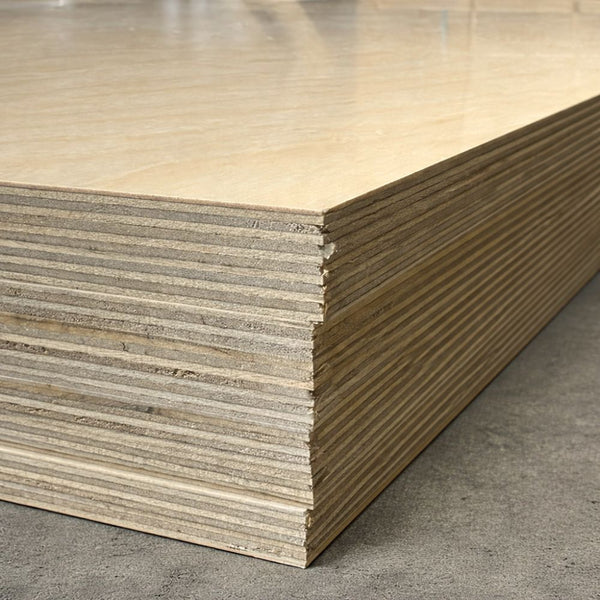
- Veneer core (alternating hardwood plies)
- Combination core (veneer with MDF or particle layers)
- Multi-ply all-birch core (higher ply count, thinner layers)
Two sheets both labeled “3/4 birch plywood” can behave very differently once cut and assembled.
Ply count
Higher ply count generally means better dimensional stability and cleaner edges. Low ply count panels rely on thicker inner plies, which are more prone to telegraphing and voids.
Face grade
Birch faces range from paint-grade to clear-grade. Patches, mineral streaks, and color variation are acceptable in some grades and unacceptable in others, depending on exposure. When Sande is another option, compare Sande and birch plywood for cabinet and shop work before choosing by face appearance alone.
Where 3/4 Birch Plywood Performs Well
When sourced correctly, this panel performs reliably in controlled interior environments.
- Cabinet boxes: Stable, square, and easy to machine with dados and rabbets.
- Closet systems: Adequate stiffness for vertical panels and supported shelves.
- Painted cabinetry: Birch faces accept paint evenly with proper prep.
This is why many shops standardize on 3/4 birch plywood for cabinets as their baseline carcass material.
Where This Material Fails
Most failures come from using the panel outside its design limits.
- High-moisture areas: Not intended for bathrooms, laundry rooms, or basements without environmental control.
- Structural loads: Not a substitute for subfloor, framing, or load-bearing panels.
- Long unsupported spans: Shelves will sag without adequate support or edge reinforcement.
Thickness does not compensate for poor core quality or wrong application.
Thickness and Specification Guidance
“3/4 inch” is nominal. Actual thickness varies by manufacturer and construction, typically ranging from 18mm to 19mm.
Key spec checks professionals make:
- Actual thickness tolerance for dado fit
- Core void frequency along cut edges
- Consistency sheet to sheet
These details matter more than the label on the bundle. Use the big-box versus cabinet-grade plywood buying guide to compare candidate sheets by their actual construction.
Common Buyer Mistakes
- Assuming all birch plywood is Baltic birch
- Using low-grade cores for exposed-edge cabinetry
- Choosing by price instead of construction
- Expecting moisture resistance from interior panels
Most callbacks trace back to one of these assumptions.
Comparison With Alternative Plywood Options
Baltic Birch Plywood
Baltic birch uses an all-birch multi-ply core with thinner layers and minimal voids. Edges are stronger and more consistent, making it better for exposed-edge cabinet construction and drawer boxes. This is why suppliers like BertaStore stock it specifically for cabinet-grade applications.
Prefinished Plywood
Prefinished panels reduce finishing labor and provide factory-applied coatings. They’re ideal for cabinet interiors and closets but limit flexibility if custom finishing or edge matching is required.
Maple or other hardwood plywood
Performance is similar when core construction matches. Species choice is usually aesthetic rather than structural.
When 3/4 Birch Plywood 4x8 Is the Right Choice
This panel makes sense when:
- The application is interior and climate-controlled
- Edges are covered or not the visual focus
- Flatness and machinability matter more than edge aesthetics
It’s a practical, predictable sheet when specified correctly and sourced from suppliers that control core quality.
For cabinet construction, many professionals pair this material with Baltic birch plywood for cabinets in areas where edge durability is critical.
When consistency matters across a job, buyers often reference individual product specs such as a 3/4 birch plywood 4x8 sheet rather than relying on generic category labels.
Related Cabinet Plywood Materials
Many cabinet shops compare standard birch plywood with other cabinet-grade sheet goods depending on edge durability, finish requirements, and project workflow.
For cabinet interiors where finishing time needs to be reduced, many builders use prefinished plywood for cabinet interiors, which arrives with a factory-applied coating.
When edge durability and multi-ply construction are critical, especially for drawer boxes or exposed cabinet edges, many professionals choose Baltic birch plywood for drawers and cabinetry.
For painted cabinetry and furniture components, some projects instead use maple plywood for cabinets, which provides a smoother face veneer and consistent grain pattern for finishing.
Planning Cuts for 4x8 Plywood Sheets
When working with 3/4 birch plywood sheets, planning cuts before purchasing material helps reduce waste and ensure accurate part sizing. You can estimate sheet usage and layout with the plywood calculator or plan cabinet parts with the plywood cut list calculator.
FAQ
Is 3/4 birch plywood strong enough for cabinets?
Yes, for cabinet boxes and supported shelves when the core quality is appropriate.
Can it be used for drawer boxes?
It can, but Baltic birch performs better due to higher ply count and stronger edges.
Is 3/4 birch plywood moisture resistant?
No. It is an interior panel unless specifically rated otherwise.
Why do some sheets warp while others stay flat?
Warping usually comes from low ply count cores, uneven moisture, or poor storage.
Is all birch plywood the same?
No. Core construction and face grade vary widely and affect performance.
Final Thoughts
3/4 birch plywood 4x8 is neither a catch-all solution nor a problem material. It’s a standard interior panel that works when its limits are respected and fails when they’re ignored.
Professionals who treat it as a system component—rather than a generic sheet—avoid surprises, reduce waste, and build assemblies that last.