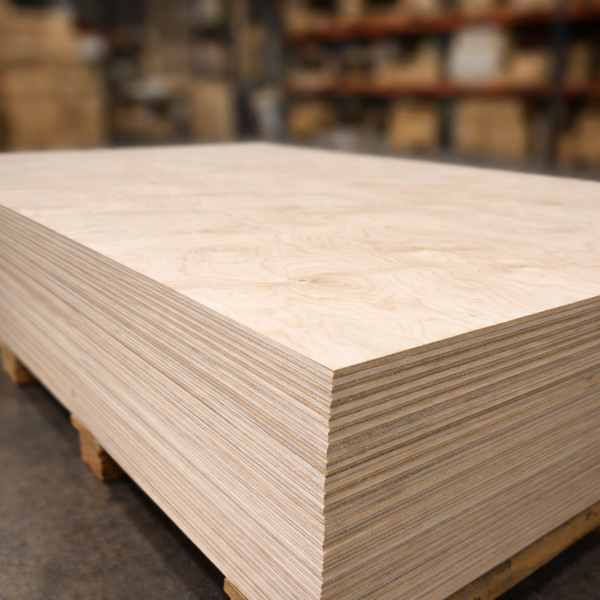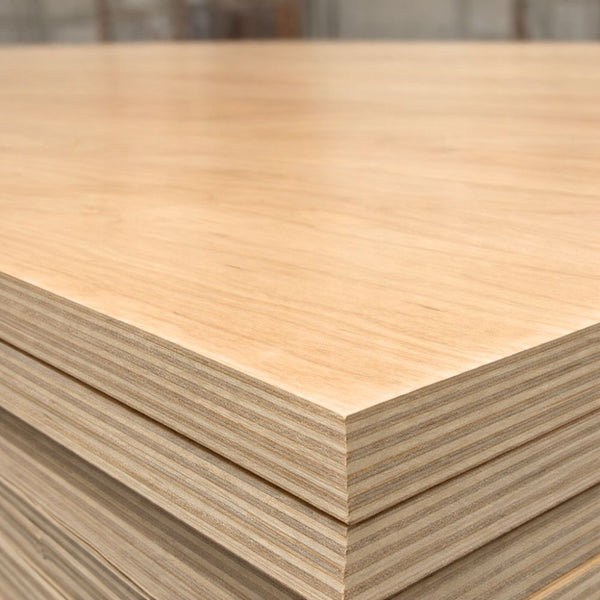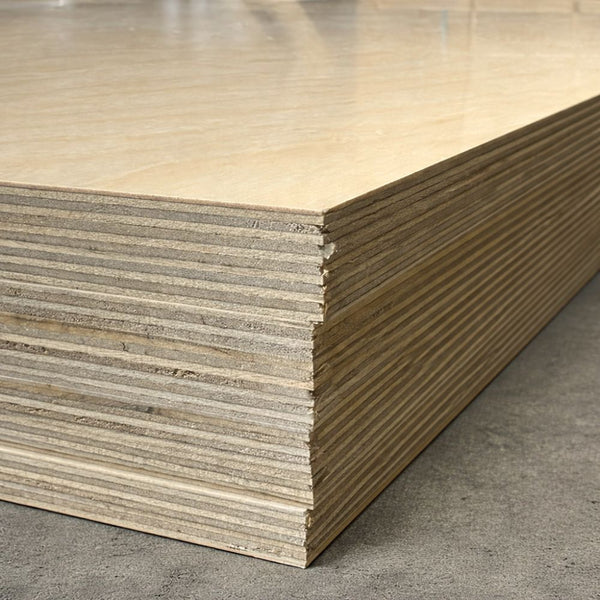

Maple plywood is one of the most commonly specified hardwood panels in cabinetry and interior construction. It offers a clean, consistent appearance, predictable machining, and reliable performance across a wide range of interior applications.
For cabinet makers and builders, maple plywood often becomes the baseline material against which other hardwood plywoods are compared. Understanding its face veneer, core construction, grades, thicknesses, and limitations helps ensure it is used where it performs best.
Maple plywood is a hardwood plywood panel with maple veneer faces bonded to a stable core. It is widely used for cabinets, furniture, and interior millwork because of its light color, uniform grain, dimensional stability, and consistent workability.
What Is Maple Plywood?
Maple plywood is manufactured with a maple veneer face and back over a stable panel core. Depending on the manufacturer and product line, that core may be made from wood veneer plies, an MDF center, or a combination of MDF and veneer layers. The face veneer controls the visible appearance, while the core has a major effect on strength, flatness, weight, edge quality, and fastening performance.
Most maple plywood uses either hard maple or soft maple veneer. Hard maple is generally lighter and denser, while soft maple may show more variation in color and grain. Both can be used in cabinet-grade panels, so the panel specification and appearance grade matter more than the species name alone. For another light-toned face, compare beech plywood material selection rather than assuming identical core or finishing behavior.
Because it is a layered panel rather than solid lumber, maple plywood is more dimensionally stable across wide surfaces. That makes it practical for cabinet sides, casework, shelving, furniture panels, and other components where controlling wood movement is important.

Prefinished Maple Plywood 4×8
Berta Store's Maple panel combines a clean Grade A Maple appearance face with a cabinet-grade hardwood plywood core and a clear UV-cured finish on both sides.
- Full 48 × 96-inch sheet format
- Available in 3/4-inch and 1/2-inch thicknesses
- Factory-finished on both faces
- Built for cabinets, furniture, shelving, and finished interiors
- Available for NJ warehouse pickup or regional delivery
How Maple Plywood Is Made
The performance of maple plywood depends as much on construction quality as it does on the maple face itself.
Face Veneer Selection
Thin maple veneer sheets are sliced or rotary-cut to create the visible face and back. These veneers are sorted by appearance, including color consistency, grain pattern, mineral streaks, repairs, and other natural markings. A cleaner appearance grade is generally selected when the panel will remain visible in finished cabinetry or furniture.
Core Construction
Veneer-core panels provide a traditional plywood structure, practical screw-holding, and lower weight than many composite-core panels. MDF-core panels are valued for flatness and a smooth edge, while combination-core panels use both veneer and composite layers to balance those characteristics.
Adhesives and Pressing
The veneer and core layers are bonded under heat and pressure. Standard cabinet-grade maple plywood is usually intended for dry interior conditions. Moisture resistance and exterior suitability depend on the adhesive classification and the complete panel specification, not on the maple face alone.
Types of Maple Plywood
| Type | Core | Typical Characteristics | Common Uses |
|---|---|---|---|
| Maple Veneer Core | All-wood veneer plies | Lighter weight, familiar plywood edge, practical fastening | Cabinet boxes, shelving, furniture, casework |
| Maple MDF Core | MDF center | Very flat surface and a smooth, uniform edge | Doors, large flat panels, veneered components |
| Maple Combination Core | MDF and veneer layers | Balances flatness with plywood-style construction | Architectural panels and interior millwork |
About Berta Store's Maple Plywood: Maple panel construction varies by manufacturer. The product sold by Berta Store is a cabinet-grade hardwood-core panel with a Grade A Maple appearance face and a factory-applied clear UV finish on both sides. It is supplied in full 4×8 sheets in 3/4-inch and 1/2-inch thicknesses.
Maple Plywood Grades and Face Quality
Maple plywood grades describe the appearance and permitted defects of the face and back veneers. Grade terminology can vary by manufacturer, so buyers should review the full panel specification rather than relying on one grade letter by itself.
- Appearance face: A cleaner face is preferred for visible cabinet interiors, furniture panels, and finished architectural work.
- Back grade: The reverse side may have a different appearance allowance when only one face will be visible.
- Core quality: Voids, ply construction, thickness consistency, and bonding quality affect machining and fastening even when the face looks similar.
- Factory finish: A prefinished panel should be evaluated for both veneer quality and the consistency of its protective surface.
Berta Store's product uses a Grade A Maple appearance face over a cabinet-grade hardwood plywood core, making it suitable where the Maple surface will remain visible.
Benefits of Maple Plywood
Maple plywood is valued for its balance of appearance, workability, stability, and broad project compatibility.
- Light, neutral color that works well in modern and traditional interiors
- Relatively consistent grain across cabinet and furniture panels
- Better dimensional stability across wide surfaces than solid Maple lumber
- Available in unfinished and factory-prefinished formats
- Well suited to repeatable cabinet and casework production
- Compatible with standard woodworking tools when blades and cutters are sharp
For shops producing repeated cabinet components, a consistent Maple face and stable core can make sheet layout, machining, assembly, and final appearance easier to control.
Common Uses of Maple Plywood
Cabinet boxes, finished interiors, side panels, partitions, backs, and shelving.
Desks, storage units, bookcases, tables, and other visible panel components.
Residential built-ins, retail fixtures, office storage, and commercial interiors.
Wall panels, finished backs, partitions, and decorative millwork in dry spaces.
Is Maple Plywood a Good Choice for Cabinets?
Yes. Maple plywood is a strong cabinet material when the project calls for a light hardwood appearance, a stable sheet, and a surface that can remain visible. It is commonly used for cabinet boxes, visible interiors, side panels, shelving, partitions, vanities, and built-in storage.
Prefinished Maple plywood is especially practical for cabinet interiors because the clear factory coating reduces the sanding, staining, sealing, and drying steps normally required after fabrication. The result is a clean interior surface that can move from cutting and edge treatment to assembly more quickly.
Where Maple Plywood Works Best in Cabinet Construction
- Cabinet sides and boxes: A rigid panel with a finished hardwood appearance.
- Visible cabinet interiors: The light Maple face provides a clean, professional look.
- Shelves and partitions: Useful where stiffness, appearance, and a finished surface matter.
- Cabinet backs and drawer bottoms: Thinner panels can reduce weight where full 3/4-inch rigidity is unnecessary.
- Built-ins and vanities: Suitable for dry interior installations that need a consistent Maple surface.
Planning cabinet boxes? Use the free cabinet box estimator, then compare sizes and current availability for cabinet-grade Maple Plywood.
Choosing Maple Plywood Sheet Size and Thickness
Full 4×8 sheets measure 48 × 96 inches and are the standard format for many cabinet, furniture, and casework layouts. Berta Store's prefinished Maple plywood is available in this full-sheet format in both 3/4-inch and 1/2-inch thicknesses. Choose between the available thicknesses using the maple plywood thickness guide for cabinet parts.
| Thickness | Best Suited For | Why Choose It |
|---|---|---|
| 3/4 inch | Cabinet boxes, side panels, shelves, furniture panels, partitions, and rigid built-ins | Provides more stiffness and load support for primary cabinet and furniture components |
| 1/2 inch | Cabinet backs, drawer bottoms, lighter interior panels, closet parts, and finished wall components | Reduces weight where a thinner finished panel is appropriate |
Actual panel thickness can differ slightly from the nominal name. Review our plywood thickness chart for nominal-versus-actual sizing, or see the guide to plywood sheet sizes when planning layouts and transportation.
Maple Plywood for Furniture
Maple plywood is also useful for furniture that relies on broad, stable panels rather than solid-wood frames alone. It can be used for desks, storage cabinets, bookcases, shelving units, table components, and custom built-ins.
Choose Maple when the visible face should have a light, understated hardwood look. For designs that expose the panel edge as a feature, compare the edge construction carefully; a multi-ply Baltic Birch panel may be the better visual choice for that specific detail.
Important Considerations Before Choosing Maple Plywood
Color and Mineral Streaks
Natural Maple can contain mineral streaks, grain changes, and tonal variation. Higher appearance grades reduce visible defects, but natural variation cannot be eliminated completely. Lay out adjacent parts before cutting when color matching is important.
Machining and Tool Sharpness
Maple is relatively dense. Sharp, clean blades and cutters help reduce burning, splintering, and tear-out, especially when crosscutting the veneer or routing exposed edges. Support the sheet properly and test critical cuts before machining finished parts.
Finishing and Staining Behavior
Unfinished Maple plywood can be painted, clear-coated, or stained, but Maple may absorb stain unevenly and develop blotchy areas without proper surface preparation. Test the complete finishing schedule on a scrap or hidden area before finishing visible parts.
Berta Store's Maple plywood is already coated with a clear UV-cured finish on both faces. It is intended to be used without additional sanding, staining, or sealing. A project that requires a fully painted or custom-stained face will generally be better served by an unfinished panel.
Interior Application Only
Standard cabinet-grade Maple plywood is intended for dry interior use. Do not assume a panel is suitable for exterior exposure, repeated wetting, or permanent moisture unless its manufacturer specifically identifies the complete panel as exterior-rated for that condition.
Maple Plywood vs Birch and Baltic Birch
Maple and Birch plywood can both work in cabinets and furniture, but the right choice depends on the appearance, core construction, edge treatment, and finish required by the project.
Choose Maple plywood when a clean, light Maple veneer is the visual priority, especially for visible cabinet interiors, furniture, shelving, and finished casework. Choose Baltic Birch when you want a dense multi-ply construction, a distinctive exposed plywood edge, or a panel commonly selected for drawer boxes, jigs, fixtures, and precision shop work.
Standard Birch plywood varies widely by grade and core. Compare the actual panel specification rather than assuming all Birch panels have Baltic Birch construction. For a deeper project-by-project comparison, read Maple Plywood vs Baltic Birch.
Maple Plywood vs Other Berta Store Panels
The panel that looks best on a finished surface is not always the panel best suited to an exposed edge, drawer box, painted project, or high-volume cabinet interior. Use the comparison below to narrow the choice.
| Material | Surface | Construction Advantage | Best Fit |
|---|---|---|---|
| Prefinished Maple Plywood | Real Maple veneer with a clear UV-cured finish | Combines a finished hardwood appearance with a cabinet-grade plywood core | Visible cabinet interiors, furniture, shelving, and finished casework |
| Baltic Birch Plywood | Birch faces with a visible multi-ply edge | Uniform ply construction and strong edge detail | Drawer boxes, jigs, fixtures, furniture, and exposed-edge projects |
| Prefinished Birch / White Melamine Plywood | Clear-finished Birch or a smooth White Melamine surface | Ready-to-use surfaces for efficient interior production | Cabinet interiors, closets, shelving, storage, and production casework |
Choose prefinished Maple when the light, natural Maple face is the priority. Browse the full cabinet-grade plywood collection when the project may benefit from a different core, surface, or edge appearance.
Prefer the clean Maple look? See available thicknesses, current pricing, pickup, and delivery details on the Maple Plywood 4×8 product page.
Frequently Asked Questions
Is Maple plywood good for kitchen cabinets?
Yes. Maple plywood is commonly used for cabinet boxes, visible interiors, side panels, shelving, partitions, backs, and vanities. A prefinished panel is especially useful when the interior Maple surface will remain visible.
What thickness Maple plywood should I use for cabinets?
Use 3/4-inch Maple plywood for most cabinet boxes, side panels, shelves, and rigid furniture components. Use 1/2-inch panels for cabinet backs, drawer bottoms, and lighter interior parts when the design does not require full 3/4-inch stiffness.
What size are Berta Store's Maple plywood sheets?
They are full 4×8 sheets, measuring 48 × 96 inches, and are available in 3/4-inch and 1/2-inch thicknesses.
Is Berta Store's Maple plywood prefinished on both sides?
Yes. The Maple faces have a factory-applied clear UV-cured finish on both sides, so the panel can be used for many interior applications without additional staining, sanding, or sealing.
Can Maple plywood be painted?
Unfinished Maple plywood can be painted when it is prepared with the appropriate sanding, primer, and paint system. Berta Store's Maple plywood is factory-prefinished, so a fully painted project will generally be better matched to an unfinished panel.
Does Maple plywood stain evenly?
Unfinished Maple can blotch or absorb stain unevenly without careful preparation. Test stain on scrap material and consider a conditioner or controlled finishing schedule. Do not stain over Berta Store's factory UV-finished surface.
Is Maple plywood stronger than Birch plywood?
Strength depends on the complete panel construction, including the core, ply count, veneer quality, and bonding. Baltic Birch is often selected for its uniform multi-ply construction, while Maple plywood is commonly selected when the Maple face appearance is more important.
Is Maple plywood suitable for exterior use?
Not unless the complete panel is specifically manufactured and rated for exterior conditions. Standard cabinet-grade Maple plywood should be kept in dry interior environments.
Helpful Maple Plywood Resources
Final Thoughts
Maple plywood is a reliable professional panel for interior cabinetry, furniture, and casework. Its value comes from a clean hardwood appearance, predictable sheet construction, broad availability, and the ability to cover wide surfaces more consistently than solid Maple lumber.
Choose it when the Maple face will contribute to the finished appearance. Compare the core, grade, thickness, and finish before ordering, and use another panel when exposed multi-ply edges, exterior exposure, or a custom painted or stained surface is the main requirement.
Shop 4×8 Prefinished Maple Plywood
Compare 3/4-inch and 1/2-inch sheets, view current pricing, check bulk-order savings, and choose NJ pickup or regional delivery.