
How to Install Undermount Drawer Slides
Install undermount drawer slides step by step using the same process cabinet makers use in the field. Covers soft-close slides, exact measurements, mounting tips, and common mistakes. Includes full installation video.
How to Install Undermount Drawer Slides (Step-by-Step)
Follow this step-by-step process to install undermount drawer slides with proper alignment, smooth movement, and soft-close function.
Undermount Drawer Slides Installation Video
Undermount Drawer Slides Installation Steps
Follow these steps to install undermount drawer slides correctly, from measuring and drawer prep to final adjustment.
Tools you need
-

Tools You’ll Need
- Measuring tape
- Pencil
- Level
- Drill
- 5 mm drill bit
- 8 mm drill bit
- Measuring tape

Step 1: Confirm Drawer and Cabinet Measurements
These undermount slides work for frameless and face-frame cabinets, but correct sizing is critical.
- The inside width of the drawer must be 29/32″ narrower than the inside width of the cabinet.
- The slide length should be at least 1-1/2″ shorter than the cabinet depth.
- The drawer length must be 9/16″ shorter than the nominal slide length.
Use the sizing chart shown in the video to confirm the correct slide length before installing.


Step 2: Prepare the Drawer Back
Before installing the slides, the drawer back needs to be prepared.
Cut a notch on the left and right bottom corners of the drawer back:
– Width: 1-3/16″ (30 mm)
– Height: 1/2″ (12.7 mm)
Drill a 5 mm hole on each side:
– 7/16″ up from the bottom
– 9/32″ in from the inside edge
These holes allow the slide hooks to lock properly into the drawer.


Step 3: Install the Locking Devices
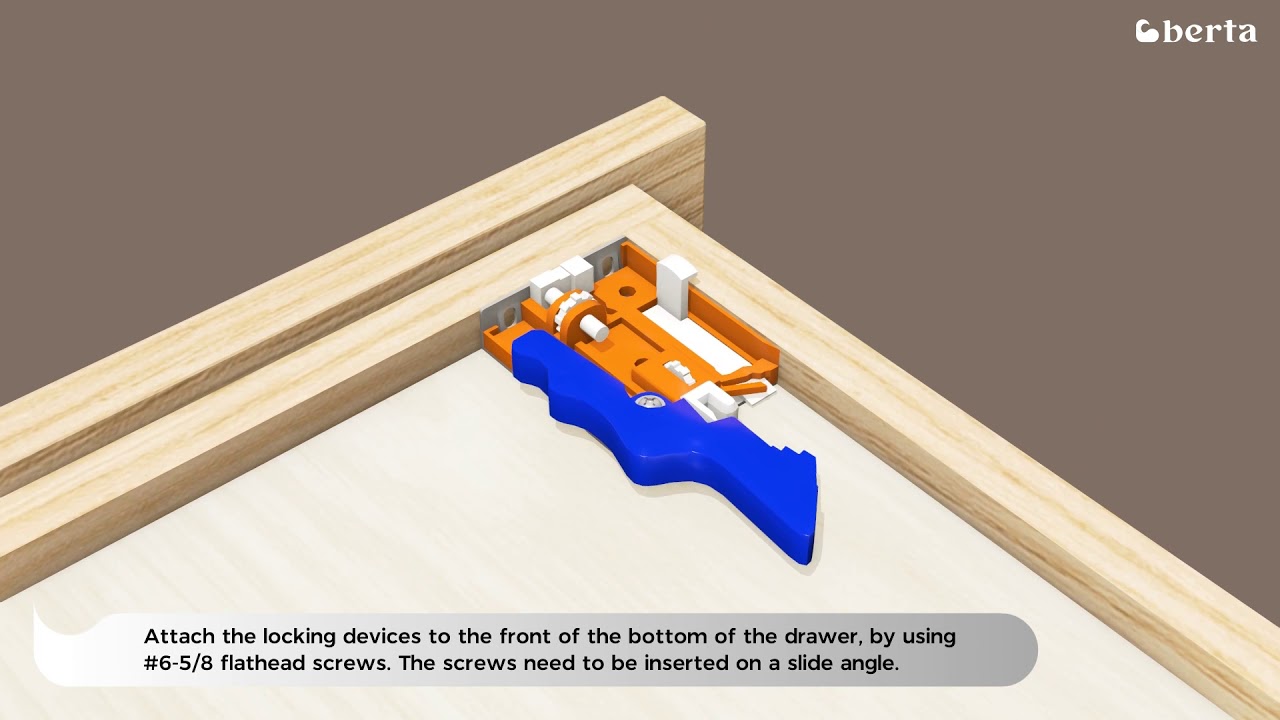
- Attach the locking devices to the front underside of the drawer.
- Use #6 × 5/8″ flathead screws.
- Drive the screws at a slight angle to ensure a tight fit.


Step 4: Attach Slides to the Drawer
- Release the locking lever on each slide.
- Hook the back of the slide into the holes drilled in the drawer back.
- Snap the slide into the locking device at the front.
Measure the distance from the top of the drawer to the bottom of the slide and note this measurement as X.


Step 5: Mark Slide Position Inside the Cabinet
- Place the drawer at the desired height inside the cabinet.
- Mark the drawer position on the cabinet wall.
- Measure distance X upward from this mark.
- Measure from that point to a fixed reference (such as the cabinet top) and record it as Z.
Use measurement Z to transfer accurate slide placement deeper inside the cabinet.


Step 6: Install Slides in Frameless Cabinets
- Align the slides with your reference marks.
- Ensure the slides are level.
- Position the slides 5 mm back from the cabinet front.
- Secure with flathead screws.
Repeat for the opposite side.


Step 7: Install Slides in Face-Frame Cabinets
For face-frame cabinets, use the rear mounting brackets provided.
- Measure and transfer X and Z to the back panel.
- Measure the cabinet frame width and record it as Y.
- Drill 8 mm holes, no deeper than 10 mm.
- Insert rear brackets into the holes.
- Mount the slides 5 mm back from the cabinet front.
- Secure with flathead screws.
Repeat on the other side.


Step 8: Insert the Drawer
- Fully extend the slides.
- Place the drawer onto the slides.
- Push the drawer in until:
Front locks snap into place
Rear hooks seat fully into the drawer holes


Step 9: Adjust the Drawer
Once installed, fine-tune the drawer position:
- Height adjustment:
Push or pull the tab on the locking device. - Side-to-side adjustment:
Turn the adjustment wheel on the locking device. - Depth adjustment:
Rotate the front wheel to move the drawer in or out.
Make small adjustments until reveals are even and movement is smooth.


Choosing the Right Undermount Drawer Slides
Undermount drawer slides are commonly used in modern cabinetry because they stay hidden beneath the drawer and allow for a clean, uninterrupted exterior. Choosing the right undermount slides before installation helps prevent alignment issues, poor drawer movement, and premature wear.
When selecting undermount hardware, the first thing to consider is drawer size and cabinet depth. Undermount slides must be matched precisely to the drawer length, and the drawer box must be built to the correct width and clearance requirements. Using slides that are too long or too short can lead to improper closing or limited extension. If you’re looking for compatible options, our selection of undermount drawer slides is designed specifically for cabinet-grade installations and standard drawer box construction.
Another important factor is the type of extension. Full-extension undermount slides allow the drawer to open completely, making it easier to access items stored in the back. This is especially useful in kitchens, pantries, and deep storage cabinets. To understand how full-extension mechanisms work and when they are the best choice, our detailed guide on full extension undermount drawer slides explains the differences and use cases in more depth.
It’s also helpful to think about the overall project. If you’re comparing different mounting styles, load ratings, or sizes across multiple drawers, browsing a complete drawer slides collection can make selection easier and ensure consistency throughout the build. This is particularly important for cabinet makers and woodworkers working on multi-drawer projects where uniform performance matters.
Taking the time to choose the correct undermount drawer slides before installation results in smoother operation, better alignment, and longer-lasting cabinetry. Proper selection paired with accurate installation ensures drawers open quietly, close evenly, and perform reliably over time.